Waytrel Journal · Security
What Is Website Penetration Testing and Do You Need It?
Learn how website penetration testing works, what vulnerabilities it uncovers, how much it costs, and when your business needs a professional security assessment.
Discuss a penetration test ↗
On this page
A website can be fast, carefully designed and doing exactly what it was built to do, and still be unsafe. Functional tests ask whether a feature works. They do not ask who else can make it work.
The more a business depends on that site, the more those gaps matter. Customer data, accounts and day-to-day operations all sit behind the same application.
Website penetration testing, often called a pentest or ethical hacking, is a controlled assessment that looks for those weaknesses and checks whether they can actually be used. The name only fits when the work is authorized.
This guide covers how a website penetration test works, what it can uncover, what it costs and which businesses should commission one. Permission, legality and the rules of an engagement are a separate subject. Why authorized web security testing is non-negotiable
1. What is website penetration testing?
Website penetration testing evaluates a website or web application for security weaknesses through controlled, authorized testing.
Ordinary quality assurance checks whether features behave as designed. A penetration test checks whether those features can be misused or reached in ways the product did not intend.
The aim is to find the weaknesses, understand the impact and recommend a fix. It is not a demonstration that a site can be attacked.
A professional website penetration test may examine:
- Authentication and login systems
- User permissions and access controls
- Session management
- Web application configuration
- APIs and third-party integrations
- Input handling and validation
- Business logic
- Sensitive data exposure
- Security-related HTTP headers
- Relevant server and infrastructure settings
Coverage follows the agreed scope. A five-page marketing site is a different engagement from a SaaS product with customer accounts, payments and several roles.
2. How is penetration testing different from a security audit?
Owners meet several related terms: security audit, vulnerability assessment, vulnerability scanning, penetration testing and secure code review. They overlap. They are not the same work.
Vulnerability scanning
Scanning uses automated tools to flag potential weaknesses: outdated components, known vulnerabilities and some configuration problems. Tools also produce false positives and miss issues that depend on how a particular application behaves.
Vulnerability assessment
A web vulnerability assessment identifies potential weaknesses, evaluates them and puts them in order. It can combine automated scanning, manual review and a risk classification. It does not, by itself, prove that a weakness can be used.
Penetration testing
A penetration test validates selected weaknesses under controlled conditions, to see whether they are real risks. Testers work manually and use tools where tools help. Website security testing in this sense is closer to an investigation than to a scan.
Security audit
A website security audit is the broader term. It can cover controls, policies, configuration, procedures and compliance requirements, not only the application.
Secure code review
A secure code review looks for security problems in the application source. It complements a test; it does not replace one.
| Assessment | Primary purpose |
|---|---|
| Vulnerability scanning | Detect potential technical weaknesses |
| Vulnerability assessment | Identify and prioritize vulnerabilities |
| Penetration testing | Validate selected weaknesses and their impact |
| Security audit | Evaluate security controls and practices |
| Secure code review | Find security problems in source code |
A mature program uses more than one of these. Scanning keeps a wide view. A penetration test answers whether a specific weakness is a business problem.
3. Why website penetration testing matters
Even a small shop now talks to payment providers, inventory, a customer database, analytics and external APIs. Each connection adds function and another place a control can fail.
Protecting customer information
Sites hold names, email addresses, addresses, account details and purchase history. Weak access control or a loose configuration can expose that information. Testing looks for the weaknesses that would break confidentiality.
Reducing business disruption
An incident can take the site down, stop orders and stall internal work. For a business that sells or delivers online, that downtime is revenue.
Protecting customer trust
Customers expect the business to handle their information with care. A serious incident damages that trust for longer than the outage lasts.
Finding weaknesses before they become incidents
Testing is a chance to fix problems while they are still preventable. It does not remove every risk.
4. What vulnerabilities can website penetration testing uncover?
Tests commonly look at the categories in the OWASP Top 10. The examples below are why those categories matter, not a catalogue of exploits. OWASP Top 10
Broken access control
Access control decides who can see information or take an action. When it fails, a user reaches something that should have stayed restricted. An online store has to keep one customer's order out of another customer's account. Testing checks whether those rules hold everywhere, not only on the obvious screens.
Injection
Injection happens when an application treats untrusted input as instructions: a database query, a command or another processor. Safer practice is parameterized queries and deliberate input handling.
Cross-site scripting (XSS)
Cross-site scripting lets untrusted content run as code in the browser. Depending on the page, that can affect sessions, what the user sees, or how the application behaves. Output encoding and safe rendering reduce the risk.
Authentication weaknesses
Authentication protects accounts and administration. An assessment may look at:
- Login and account recovery
- Multi-factor authentication
- Session expiration
- Cookie security
- Account enumeration
- Rate limiting
- Administrative access
Weak controls here raise the chance of unauthorized access.
Security misconfiguration
A sound application can still be exposed by the way it is deployed: extra services, an open admin interface, permissions that are wider than the job, or production settings that belong in a lab.
Vulnerable dependencies
Frameworks, libraries, plugins and packages carry their own flaws. An old component can expose a known issue. Updates and a record of what the site depends on are part of the fix, not a one-off scan.
Business logic
Some weaknesses come from how a process is implemented, not from a classic coding mistake. Purchase limits, account permissions and transaction rules are typical examples. Scanners do not know what the business meant. A person has to.
5. How does website penetration testing work?
A professional test follows a method. It starts with written authorization and a scope both sides can point to.
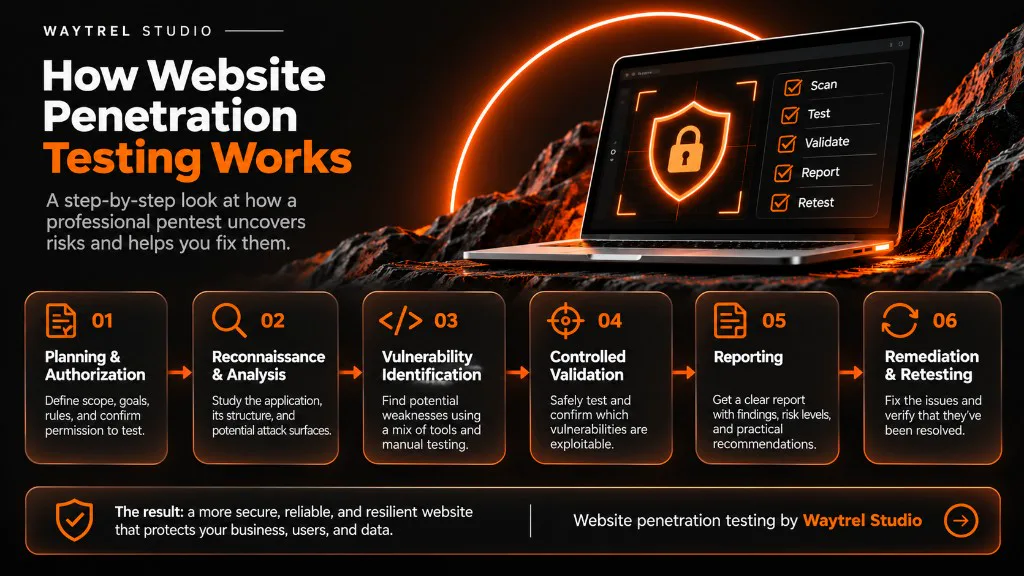
Stage 1: Planning and authorization
Before anything runs, the organization and the provider agree the boundary:
- Systems in scope
- Objectives
- Permitted activities
- Schedule
- Operational restrictions
- Emergency contacts
- Reporting
- How data will be handled
Those details usually live in Rules of Engagement. Written permission matters because testing without it can break the law or a contract. The legal side of that line is covered separately. Authorized web security testing
Stage 2: Reconnaissance and analysis
The team studies the agreed environment: what the application does, which roles exist, which systems it talks to, and which settings are relevant. The point is to decide where a closer look is worth the time.
Stage 3: Vulnerability identification
Tools can surface common issues. Manual work is what evaluates authorization, business rules and behavior that is specific to this application.
Stage 4: Controlled validation
Selected findings are checked inside the scope, enough to show that a weakness is a real risk, and no further. A careful test avoids unnecessary access to sensitive data and stays inside the agreed limits.
Stage 5: Risk assessment and reporting
The report should say what was found, which systems are affected, why it matters, what it could do to the business, how to fix it, and what the assessment did not cover.
Stage 6: Remediation and retesting
Developers and administrators fix the issues. A retest checks that the reported ones are actually gone. The value of the test is the fix, not the list of findings.
6. What types of websites need penetration testing?
Not every site needs the same depth. Some kinds of application benefit more than others.
Online stores
Stores handle customer information, orders and payment flows. A useful scope looks at account protection, checkout integrity, who can open an order, payment integrations, discount and refund logic, and admin permissions. Custom plugins add risk that a generic scan will not understand.
SaaS applications
A SaaS product often holds data for many customers. The questions that matter are tenant isolation, user permissions, API authorization, authentication, data boundaries and admin functions. One customer must not be able to read another's data.
Corporate websites
A corporate site may include an employee portal, forms, a CMS and outside integrations. It can still expose internal information or the organization's reputation without ever taking a payment.
WordPress and WooCommerce
WordPress and WooCommerce are flexible because of plugins, themes and custom code. An assessment may cover:
- Core, plugin and theme versions
- User roles and capabilities
- Custom theme behavior
- REST API permissions
- Authentication and sessions
- Hosting configuration
- Third-party integrations
- Custom WooCommerce workflows
A maintained WordPress site can be secure. Security depends on configuration, how custom code was written, and whether someone keeps it updated.
Custom web applications
Specialized business rules need a test shaped around them. A scanner will not see a flaw in a custom authorization scheme or an unusual workflow. That is where manual testing earns its place. When the application itself needs to change, that is a development question, not only a testing one. Bespoke website development
7. How often should you perform website penetration testing?
There is no single calendar. Frequency should follow the risk, the complexity and how often the application changes.
A test is especially useful:
- Before a new application launches
- After a major change in functionality
- After a significant infrastructure change
- When a sensitive integration is added
- After a security incident
- When a contract or a standard requires it
- As part of an ongoing assurance program
Some organizations use an annual test as a baseline. Higher-risk or fast-changing systems need it more often. Continuous vulnerability monitoring helps between tests. It does not replace the manual work.
8. How much does website penetration testing cost?
Price follows scope and complexity. A small site with little logic is less work than a SaaS platform with many roles, APIs and integrations.
What moves the price:
- Number of applications and endpoints
- Application complexity
- Authentication requirements
- Number of user roles
- API coverage
- Infrastructure scope
- How much of the work is manual
- Reporting
- Whether retesting is included
The figures below are broad planning examples. They are not verified market averages and they are not Waytrel Studio quotations. Waytrel Studio publishes its own starting prices separately, and the written scope fixes the price before testing begins. Web application penetration testing, published prices
| Project type | Illustrative budget |
|---|---|
| Small business website | $500–$2,000 |
| WordPress or WooCommerce website | $1,000–$5,000 |
| Custom business web application | $2,000–$10,000 |
| SaaS platform with APIs | $5,000–$20,000+ |
| Complex enterprise environment | Custom quotation |
Real prices fall outside these bands depending on geography, scope and who does the work. An inexpensive automated scan is not a manual penetration test. Before comparing quotes, ask what each provider actually includes.
9. How to prepare your website for a penetration test
Preparation makes the assessment safer and more useful.
Define the scope
Name the websites, applications, APIs and infrastructure to include. Confirm you have the authority to approve testing for every one of them.
Name the critical functions
Tell the provider about checkout, payments, account management and anywhere customer data is processed, so the restrictions match the risk.
Arrange test accounts
Where roles differ, provide an account for each level so access control can be checked as it is meant to work. Use dedicated test accounts. Do not hand over production credentials that are not needed.
Prepare backups and recovery
Have backups and a recovery path before the window opens. Even a careful test can create operational risk.
Tell the people who will notice
Developers, hosting administrators, security staff and support should know the window and how to escalate.
Agree the report
Settle the format, how severity is classified, how you will communicate, and whether fixes will be retested. A prepared engagement is calmer for both sides.
10. Can penetration testing damage your website?
A test interacts with systems in ways ordinary users do not. Poorly controlled activity can affect performance, data or availability.
Professional providers reduce that risk with a defined scope, written authorization, restrictions, safeguards, a communication path, controlled validation and a condition for stopping. Sensitive production systems may need some checks limited, or run on a representative staging environment. No honest provider promises that every possible test activity is risk-free.
11. Does a penetration test guarantee website security?
No. A test describes selected systems at one moment. It cannot promise that every weakness was found.
New risk appears afterwards through releases, plugin updates, configuration changes, new integrations, infrastructure changes and vulnerabilities that were not public on the day of the test.
Treat the test as one part of a wider practice: secure development, monitoring, backups, access reviews, dependency management and an incident plan. After the fixes, the site still needs someone to keep it updated. Website maintenance and support
Security is a continuing practice, not a certificate you hang on the wall.
12. How to choose a website penetration testing provider
Look for technical competence, a clear scope and restraint. Useful questions:
Do they require written authorization?
A legitimate provider sets permission and boundaries before the work starts, and will not start without them.
Which method do they follow?
Common references:
These documents make proposals easier to compare.
Is manual testing included?
Manual analysis is what finds access-control and business-logic weaknesses. Ask whether it is in the price or sold as an extra.
What does the report include?
Ask for a sample with confidential detail removed. A useful report has clear findings, a risk rating, evidence and remediation guidance.
Is retesting available?
Retesting is how you know a fix worked. Price and schedule it up front.
Do they know your stack?
Experience with WordPress, WooCommerce, SaaS, APIs or the framework you actually use makes the assessment more specific. So does the honesty to decline work outside that experience.
How do they protect sensitive information?
Ask how credentials, evidence and confidential data are stored, who can see them, and when they are deleted.
13. Website penetration testing and compliance
Testing can support compliance and risk management. Depending on the business, relevant frameworks include PCI DSS, ISO/IEC 27001, SOC 2, security duties connected to the GDPR, and industry standards.
A penetration test does not, by itself, make an organization compliant. Frameworks differ, and some do not apply. Obligations should be checked with people qualified to advise on security and compliance. This guide is not that advice.
14. How Waytrel Studio approaches website security
At Waytrel Studio, a digital product needs more than a considered visual design. It also needs reliable engineering, a structure that can be maintained, and attention to security.
For website penetration testing, that means practical risk reduction: clear authorization and boundaries, an understanding of the architecture, findings that matter, responsible validation, a report the team can act on, and a check that the fix worked.
The work is led by the developer who builds and maintains these systems. We do not claim certifications we do not hold. When a project needs a certified auditor or a formal attestation, we say so.
Published starting prices, and what each scope includes, are on the penetration testing service page. Web application penetration testing
Security belongs throughout the life of a WordPress site, a WooCommerce store, a SaaS product or a custom application. Building it and looking after it are part of the same decision. Bespoke website development · Website maintenance and support
15. Website penetration testing checklist
Before commissioning a test, answer these:
- Have we named the systems to test?
- Do we have authority to approve the assessment?
- Is the scope written down?
- Are the restrictions clear?
- Have we named the critical workflows?
- Are test accounts ready?
- Are backups and recovery in place?
- Have the relevant teams been told?
- Will the provider deliver a detailed report?
- Is help with remediation available?
- Can important fixes be retested?
A structured engagement turns the test into a repair, not only a document.
Frequently asked questions
What is website penetration testing?
It is an authorized assessment that finds and validates weaknesses in websites, web applications and the systems around them.
Is website penetration testing legal?
It is generally done with explicit permission from the party entitled to approve it. Legality also depends on the jurisdiction, the contract, the methods and the systems. This is general information, not legal advice. Authorized web security testing
How long does a website penetration test take?
A small assessment may take several days. A complex application can take weeks. Scope, complexity and the report decide the calendar.
Is penetration testing necessary for small websites?
Not every small site needs a full penetration test. Sites that process customer information, support accounts or depend on sensitive integrations often do.
Can automated tools replace professional penetration testing?
Tools are good at common, known issues. They miss problems that are specific to the application, and they miss subtle authorization failures. Manual analysis still matters.
Does HTTPS mean my website is secure?
No. HTTPS encrypts data in transit. It does not remove application weaknesses, bad configuration or broken access control.
Can penetration testing improve website performance?
Performance is not the point of the test. An assessment can still surface configuration or structural issues that also affect reliability.
What happens after vulnerabilities are discovered?
The provider documents the findings and recommends fixes. The development or infrastructure team implements them. A retest checks the result.
Final thoughts: does your business need website penetration testing?
A penetration test shows weaknesses that ordinary functional testing does not. For stores, SaaS products, customer portals and custom platforms, that is often the difference between assuming a control works and knowing whether it does.
It is not a substitute for secure development, maintenance or monitoring. The useful combination is a test when the risk justifies it, and engineering that does not wait for the test.
The goal is not to prove the site cannot be compromised. It is to find and reduce the risks that matter.
Related services
- Web application penetration testing
- Website maintenance and support
- Web development
- UI/UX and product design
Related reading
- How ethical hacking for websites keeps your business safe
- Why authorized web security testing is non-negotiable
- Bespoke website development: process, cost and benefits
- How to hire a digital design studio in 2026
Prepared by Waytrel Studio. This is general guidance, not legal advice. The budget table is illustrative and is not a Waytrel Studio quotation. Waytrel Studio does not claim certifications it does not hold.