Waytrel Journal · Web development
Bespoke Website Development: Process, Cost & Benefits
What bespoke website development involves, how it differs from templates, what it costs, how long it takes and when it is worth the investment.
Discuss my project ↗
On this page
Your website should not have to adapt to the limitations of a template. Ideally, it adapts to the needs of your business.
For many companies, website builders and ready-made themes are a reasonable starting point. They are accessible, relatively affordable and capable of a professional result.
As a business grows, the website often has to do more than present information: integrate with internal systems, automate routine operations, support complex customer journeys or carry a distinctive brand identity. That is where bespoke website development becomes relevant.
This guide covers what bespoke development involves, how much it costs, how long it takes and when the investment is justified.
1. What bespoke website development is
Bespoke website development is the process of designing and building a website around a specific business's requirements instead of starting from a preconfigured template. Bespoke means made for a particular purpose or customer.
In web development that can involve custom interfaces, specialised functionality, unique integrations and an architecture built around how the company actually operates.
A bespoke website might include:
- A distinctive visual identity and interactive experience
- Custom navigation and content structures
- Customer portals and personalised dashboards
- Advanced eCommerce functionality
- CRM, ERP and third-party API integrations
- Custom booking or subscription systems
- Automated business workflows
- Multilingual content management
- Specialised search and filtering
- A frontend architecture built for performance
Not every bespoke project builds everything from scratch. A custom website can still use established frameworks, libraries and content management systems.
The difference is that technology is chosen and adapted to the project's requirements, instead of a template deciding what the business can do.
Bespoke development is about intentional customisation, not unnecessary complexity.
2. Bespoke websites and templates compared
Template-based websites and bespoke solutions can both deliver excellent results. The main distinction is how much flexibility and technical control the project requires.
| Feature | Template-based website | Bespoke website |
|---|---|---|
| Initial investment | Generally lower | Generally higher |
| Launch speed | Usually faster | Needs more planning |
| Design freedom | Limited by the platform and theme | Greater creative flexibility |
| Custom functionality | Depends on available features | Tailored to requirements |
| Integrations | Platform-dependent | Greater implementation flexibility |
| Performance | Depends on platform and setup | Can be optimised specifically |
| Scalability | Suitable for many standard needs | Architecture can be tailored |
| Maintenance | Often simpler | Requires technical support |
| Brand differentiation | Possible within template constraints | Greater control over the experience |
A template is not inherently worse. For a small business that needs a professional website with standard functionality, a well-configured theme may be the most practical choice.
Businesses with unusual requirements often find that bending an existing platform costs more than building a solution designed around those requirements.
The goal is to choose the right level of customisation.
3. The benefits of bespoke development
A custom build is worth considering for what it changes in day-to-day work, not for its label.
A website built around your business
Every business has its own processes, customers and objectives. Bespoke development lets those requirements shape the product from the beginning.
Instead of forcing your workflows into existing functionality, developers can create interfaces and systems that support how the business actually operates. A company might need a customer portal that connects order information, support requests, invoices and internal systems; a custom solution brings those functions into one coherent experience.
Greater design freedom
A website is often one of the first interactions a customer has with a brand. Bespoke development lets designers and developers create a distinctive experience through:
- Custom layouts and typography
- Unusual navigation patterns
- Interactive storytelling
- Purposeful animation
- Responsive interface components
- Brand-specific visual systems
This flexibility matters most for creative businesses, technology companies and brands that compete through digital experience. Design freedom still has to serve usability: an unusual interface is not automatically a better one.
More control over performance
Performance affects user experience, engagement and often conversion. Custom development lets engineers make deliberate decisions about:
- JavaScript execution
- Rendering strategies
- Image optimisation
- Font loading
- Caching
- Database queries
- Third-party scripts
- Hosting infrastructure
That can produce a fast, efficient website tuned to a specific use case. Custom code does not guarantee it: a poorly engineered bespoke website can be slower than a carefully optimised template.
Flexible integrations and automation
The strongest reason to invest in bespoke development is usually the ability to connect the website with business operations. Examples:
- Synchronising orders with an ERP
- Integrating customer information with a CRM
- Connecting custom payment workflows
- Automating inventory updates
- Building personalised customer dashboards
- Connecting external APIs
- Generating reports from several systems
These capabilities reduce repetitive work and improve operational efficiency. For some businesses the value of automation outweighs the value of the visual design.
Control over future development
A bespoke website can be structured to support what comes next: new integrations, additional languages, customer accounts or more sophisticated functionality.
The benefit depends on architecture and code quality. Custom development creates room for flexibility, but keeping it requires sound technical decisions and documentation.
4. The bespoke website development process
A successful custom website takes more than writing code. It takes understanding the business, planning the experience, designing the interfaces, building the functionality and validating the result.
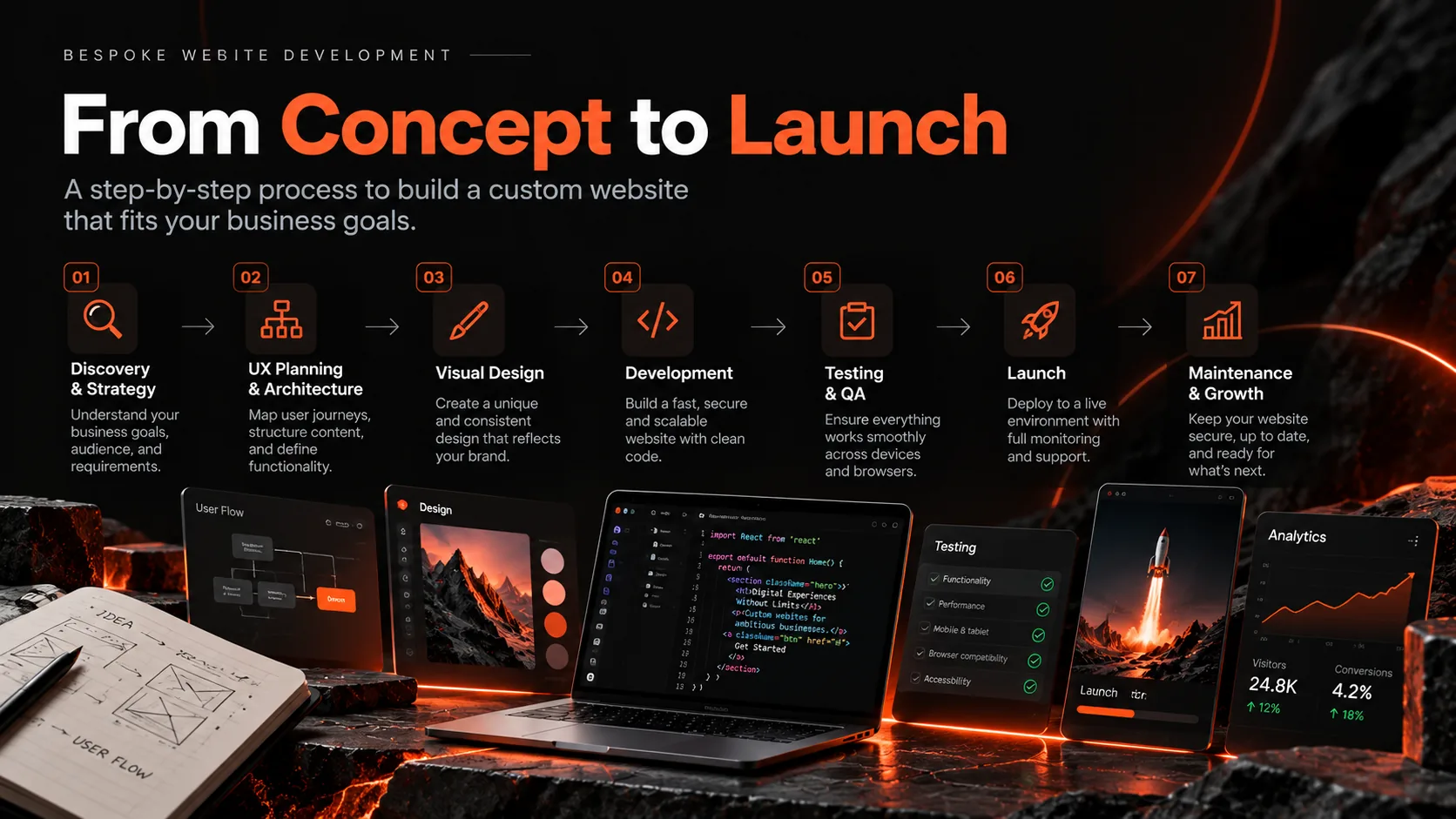
Stage 1: Discovery and strategy
The process starts with understanding what the website needs to accomplish. That usually means discussing:
- Business objectives
- Target audiences
- Existing problems
- Competitors and market positioning
- Functional requirements
- Technical constraints
- Budget and timeline
The objective is to define what success looks like before development begins. A clear discovery phase prevents unnecessary features and expensive changes later.
Stage 2: UX planning and information architecture
Once the requirements are clear, the next step is organising the user experience:
- Website structure
- User journeys
- Navigation
- Wireframes
- Content hierarchy
- Conversion paths
At this stage the team focuses on how the website should work before deciding exactly how it should look.
Stage 3: Visual design
The visual identity becomes a functional interface. Design decisions cover:
- Typography
- Colour
- Layout systems
- Interactive components
- Responsive behaviour
- Motion and transitions
- Accessibility
A strong design process balances brand expression with usability.
Stage 4: Frontend and backend development
This is where approved designs become a working website. Frontend development handles the interface; backend development manages the systems behind it, such as databases, authentication, business logic and integrations.
Depending on requirements, a bespoke website might use React, Next.js, Laravel, WordPress with custom functionality or another appropriate stack. Technology is selected for the needs of the project, not for the trend of the season.
Stage 5: Testing and quality assurance
Before launch, the website is tested across relevant devices, browsers and user scenarios:
- Functional testing
- Responsive layout checks
- Accessibility testing
- Performance testing
- Security review
- Integration testing
- Form and checkout validation
- SEO checks
The depth of testing should match the complexity and risk of the project.
Stage 6: Deployment and launch
The website goes to its production environment. That can involve configuring hosting, domains, SSL certificates, caching, monitoring, backups and deployment workflows.
If an existing website is being replaced, URL redirects and an SEO migration plan are part of the work.
Stage 7: Maintenance and improvement
Launch is not the end of development. Websites need updates, monitoring, fixes and occasional improvements. As requirements evolve, new functionality is added through the same structured process.
5. How long does bespoke website development take?
Timelines depend on scope, technical complexity, content readiness and how quickly feedback and approvals arrive.
The ranges below are illustrative planning figures, not delivery guarantees.
| Project type | Estimated timeline |
|---|---|
| Custom landing page | 2–4 weeks |
| Small business website | 4–8 weeks |
| Corporate website | 6–12 weeks |
| Custom eCommerce website | 8–20 weeks |
| Complex web platform | 3–9+ months |
A relatively simple website with a unique visual design can move quickly. A platform with user accounts, business logic, integrations and several stakeholders needs more planning and testing. Timelines also grow when requirements change significantly during development.
The best way to estimate a bespoke project is to define its scope before committing to a launch date.
6. How much does bespoke website development cost?
There is no universal price. Cost depends on:
- Project scope
- Design complexity
- The number of unique pages and templates
- Custom functionality
- Integrations
- Content requirements
- Team experience
- Testing requirements
- Maintenance expectations
The ranges below are examples for early planning. They are not verified market averages and not Waytrel Studio quotations.
| Project type | Illustrative budget |
|---|---|
| Custom landing page | $1,000–$5,000 |
| Small bespoke business website | $3,000–$12,000 |
| Corporate website | $8,000–$30,000 |
| Custom eCommerce solution | $10,000–$50,000+ |
| Complex web application | $25,000–$100,000+ |
Actual quotes can fall outside these ranges depending on the market, the requirements and the delivery model. A bespoke website is better evaluated as a business investment than as a collection of pages.
Total cost of ownership
The initial build is only one part of the investment. Over time a business also pays for:
- Hosting and infrastructure
- Domain registration
- Maintenance
- Security updates
- Monitoring and backups
- Third-party services
- New features
- Technical improvements
Comparing the expected total cost over three to five years is more useful than comparing the first invoice. A more expensive build can deliver better value if it removes manual work, supports important integrations or avoids a rebuild. A simple website that meets the need can still be the economical option.
7. Is bespoke development better for SEO?
A bespoke website gives more control over technical SEO. It does not automatically rank better.
Search engines weigh content relevance, website structure, usability and technical implementation. Custom development provides flexibility in:
- Semantic HTML
- Structured data
- Metadata generation
- URL architecture
- Canonical URLs
- International SEO
- Rendering strategies
- Internal linking
- Image optimisation
- Core Web Vitals
For complex content structures or multilingual requirements that control is valuable. Poor architecture, unnecessary JavaScript and incorrect indexing settings can create SEO problems on a custom build just as easily.
Good SEO needs a coordinated content and technical strategy, whatever the platform.
8. When bespoke development is worth the investment
Bespoke development pays off when the website carries part of the business operation. Consider a custom solution when:
- The website needs specialised functionality
- You need integrations with internal systems
- The brand depends on a distinctive digital experience
- Existing platforms require extensive workarounds
- You need greater control over architecture and performance
- Your business has complex customer journeys
- Significant changes in functionality are expected over time
The strongest justification is usually a clear business requirement that standard tools cannot meet efficiently. Custom development should solve a problem; being custom is not a goal in itself.
9. When a template-based website is enough
Not every business needs bespoke development. A website builder or an existing theme may be the better choice when:
- The budget is limited
- The website has to launch quickly
- The requirements are relatively standard
- Complex integrations are not needed
- You prefer to manage the website yourself
- The business is still validating its first idea
A small consulting business, for example, may need only a homepage, a services page, a contact form and a blog. A professionally configured template covers that without the cost of a custom build.
Choosing the simpler solution when it fits is a sound business decision.
10. Common mistakes to avoid
Starting without clear requirements
Unclear objectives lead to scope changes, delays and unexpected costs. Document the core requirements before development begins.
Prioritising visual effects over usability
Animation and interactive elements improve an experience when they are used deliberately. Excessive motion, complicated navigation and heavy visual effects create friction. Design should support the user, not distract from the task.
Ignoring performance until launch
Performance belongs in design and architecture planning. Optimising a poorly structured website at the end of development is expensive.
Overengineering the solution
Not every website needs a complex frontend framework, microservices or a custom content management system. The simplest architecture that reliably meets the requirements is usually the best choice.
Forgetting about maintenance
A custom website needs an ongoing support strategy. Before launch, clarify who handles updates, backups, monitoring and technical issues.
11. How Waytrel Studio approaches bespoke development
Waytrel Studio builds websites as one connected process: strategy and structure, interface design, frontend and backend engineering, then support after launch. waytrel.studio
The goal is not complexity for its own sake. A bespoke website should feel distinctive without losing clarity, look considered without becoming heavy, and be technically capable without systems the business does not need.
That approach puts emphasis on:
- Thoughtful interface design
- Practical technical architecture
- Performance-conscious development
- Purposeful interaction and animation
- Search engine accessibility
- Maintainability and future flexibility
For businesses moving beyond standard templates, the objective is a website that reflects their identity and supports how they work.
12. Questions to ask before hiring a studio
Before choosing a development partner, ask:
- Have you delivered projects with similar technical requirements?
- How do you approach discovery and planning?
- Which technologies would you recommend, and why?
- How are design and development coordinated?
- What testing is included?
- How do you handle performance and SEO?
- Who owns the source code and design assets?
- How are milestones and payments structured?
- What happens when requirements change?
- What support is available after launch?
A reliable partner explains the process and technical decisions clearly. Transparency is usually worth more than ambitious promises.
Final thoughts: is bespoke development worth it?
Bespoke website development is a sound investment for businesses that need more than standard website functionality: flexibility in design, architecture, integrations and long-term product development.
It also asks for more planning, technical expertise and ongoing responsibility.
Choose bespoke development when the requirements justify the additional investment, and a simpler solution when it already meets the need. The best website is not the most expensive, complex or visually impressive one; it is the one that supports the business.
Related services
Related reading
- App design agency: what to look for before you hire
- Design and development studio vs. separate freelancers
Prepared by Waytrel Studio on 27 October 2026 from our own project practice. The illustrations are studio concept renders; the figures on their screens are demo values, not studio metrics.