Waytrel Journal · Security
Why Authorized Web Security Testing Is Non-Negotiable in 2026
What authorized web security testing involves, why permission is the line that matters, how an engagement runs from scoping to retesting, and what a useful security report contains.
Discuss a security review ↗
On this page
A website can look finished and still be exposed. Fast pages, clean design and a checkout that works say nothing about whether one customer can open another customer's invoice.
That is the uncomfortable part of web security: a site can do exactly what it was built to do and still be unsafe.
As more business runs through websites, security stops being a concern for large enterprises only. Online stores, SaaS products, service businesses and small brands all hold data worth stealing or breaking.
Authorized web security testing is the work that finds those weaknesses with permission, inside agreed boundaries, before someone with worse intentions does. This guide covers what the work involves, why authorization is the line that matters, how an engagement runs, what a report should contain and when to commission one.
1. What is authorized web security testing?
Authorized web security testing is the process of evaluating a website, web application or supporting infrastructure for security weaknesses with explicit permission from the system owner or another party legally entitled to authorize the work.
The objective is straightforward: identify weaknesses before an attacker can use them.
Unlike unauthorized activity, legitimate testing operates within an agreed scope, follows defined rules and produces recommendations the client can act on. Permission is not a formality; it is what separates a security assessment from an intrusion.
Depending on the engagement, testing can include:
- Web application vulnerability assessments
- Authentication and session security reviews
- Access control testing
- API security assessments
- Server and infrastructure configuration reviews
- Security header and TLS configuration checks
- Business logic security assessments
- Third-party integration reviews
- Secure code reviews
- Controlled penetration testing
These activities show where controls may be insufficient. They are not all the same thing, and a proposal should be clear about which ones it covers.
A vulnerability assessment identifies and evaluates potential weaknesses. A penetration test goes further and safely validates selected weaknesses inside an explicitly authorized scope. Both produce useful information; they answer different questions.
2. Why web security matters more than ever in 2026
A modern site is not a collection of static pages. It is a set of connections between systems that each have their own users, permissions and failure modes.
A typical business website talks to:
- Payment gateways
- Customer relationship management systems
- Inventory platforms
- Analytics services
- Authentication providers
- Marketing automation tools
- Cloud infrastructure
- External APIs
- AI-powered services
Every connection is a dependency to understand and secure. A weakness in one component can reach another.
A misconfigured API can expose customer data while the frontend looks completely fine. An outdated dependency or a loose access rule creates risks that ordinary functional testing never shows, because functional testing asks whether the site works, not who else can make it work.
Security is a business issue
The consequences of an incident go beyond technical disruption. They can include:
- Unauthorized access to customer data
- Operational downtime
- Financial losses
- Regulatory investigations
- Reputational damage
- Incident response expenses
- Loss of customer trust
Severity depends on the systems affected, the information involved and how quickly the organisation can respond. Two similar technical bugs can have very different business outcomes.
For a business that earns through its website, security testing belongs in operational risk management, next to backups, uptime and payment reliability.
3. Why authorization is essential
The most important line in security work runs between authorized testing and everything else.
Good intentions do not create permission. Testing a system without it can violate law, contract or acceptable-use policies, even when nothing is damaged and no data is taken.
Professional work starts with documented authorization, before the first request is sent.
What authorization should include
A proper engagement defines:
- System ownership: who has authority to approve the testing?
- Scope: which domains, applications, APIs and environments are included?
- Testing window: when is testing permitted?
- Permitted techniques: which assessment activities are allowed?
- Restrictions: which actions, systems and data are excluded?
- Emergency contacts: who is called if something breaks?
- Reporting requirements: how are findings and sensitive details communicated?
- Data handling: how is collected evidence protected and eventually deleted?
A written Rules of Engagement document makes these boundaries explicit for both sides. It is also the first thing a serious provider asks for.
Why this protects both parties
Clear authorization protects the client by establishing accountability, safeguards and an escalation path if a test affects availability.
It also protects the tester by defining what may be assessed and what must be left alone. On third-party hosting, provider approval may be required as well, and that check belongs in scoping rather than in the middle of testing.
Ethical security testing is about permission, transparency and responsible execution, not only technical skill.
4. Vulnerability assessment vs. penetration testing
The terms are often used as synonyms. They describe different activities with different outputs.
| Category | Vulnerability assessment | Penetration testing |
|---|---|---|
| Primary objective | Identify potential weaknesses | Validate security risks through controlled testing |
| Typical approach | Automated and manual review | Manual analysis supported by tools |
| Depth | Broad coverage | Focused validation of selected risks |
| Output | Findings and risk classifications | Validated findings, impact and remediation guidance |
| Authorization | Required | Required |
| Best suited for | Regular security monitoring | Deeper security assurance |
Neither approach replaces the other. An assessment covers a wide surface quickly; a test answers whether a specific weakness creates a real business risk.
For many organisations the useful answer is both: regular assessments across the estate, plus a deeper test before a launch or after a significant change.
5. Common web application security risks
Most reviews keep returning to the same families of weakness. The OWASP Top 10 is the common public reference for them. OWASP Top 10
Broken access control
Access control decides who may see a record and who may change it. When it fails, a user can reach data or actions that were never meant for them.
A customer portal must stop one customer from reading another customer's invoices. The check has to run on the server; hiding a button in the interface is not a control.
Injection vulnerabilities
Injection happens when untrusted input reaches a database query, a command or another interpreter without safe handling.
Parameterised queries, strict input handling and avoiding unsafe command construction remove most of this class. The fix belongs in code review and in the development standard, not only in a scanner report.
Authentication and session weaknesses
Authentication protects user accounts and administrative access. A review may examine:
- Password and account recovery controls
- Multi-factor authentication
- Session expiration
- Cookie security
- Account lockout and rate limiting
- Privilege management
Weak controls here raise the chance of account takeover, which is often the first step toward everything else.
Security misconfiguration
A well-written application can still be exposed by its configuration. Common findings include:
- Exposed administrative interfaces
- Unnecessary services
- Excessive permissions
- Debug settings enabled in production
- Insecure cloud storage configurations
- Missing security updates
Configuration review matters because no amount of code quality fixes an admin panel left open to the internet.
Vulnerable or outdated components
Sites depend on libraries, frameworks, plugins and packages. A known vulnerability in one of them is an open door until it is patched or mitigated.
A dependency process does more than an annual scan: inventory what is installed, update on a schedule, and remove what nobody uses.
Business logic vulnerabilities
Some weaknesses are not coding errors. The application does what it was told, and the business process can still be bent in a way nobody intended.
Discounts, refunds, role changes and checkout steps are common examples. Scanners rarely find them because finding them requires understanding what the process is supposed to do.
This is where manual testing earns its place. It is also why the scope should include the business rules, not only the endpoints.
6. How authorized testing works
A professional engagement follows a structured process. The details depend on the application, the client's objectives and the agreed scope, but the shape stays similar.
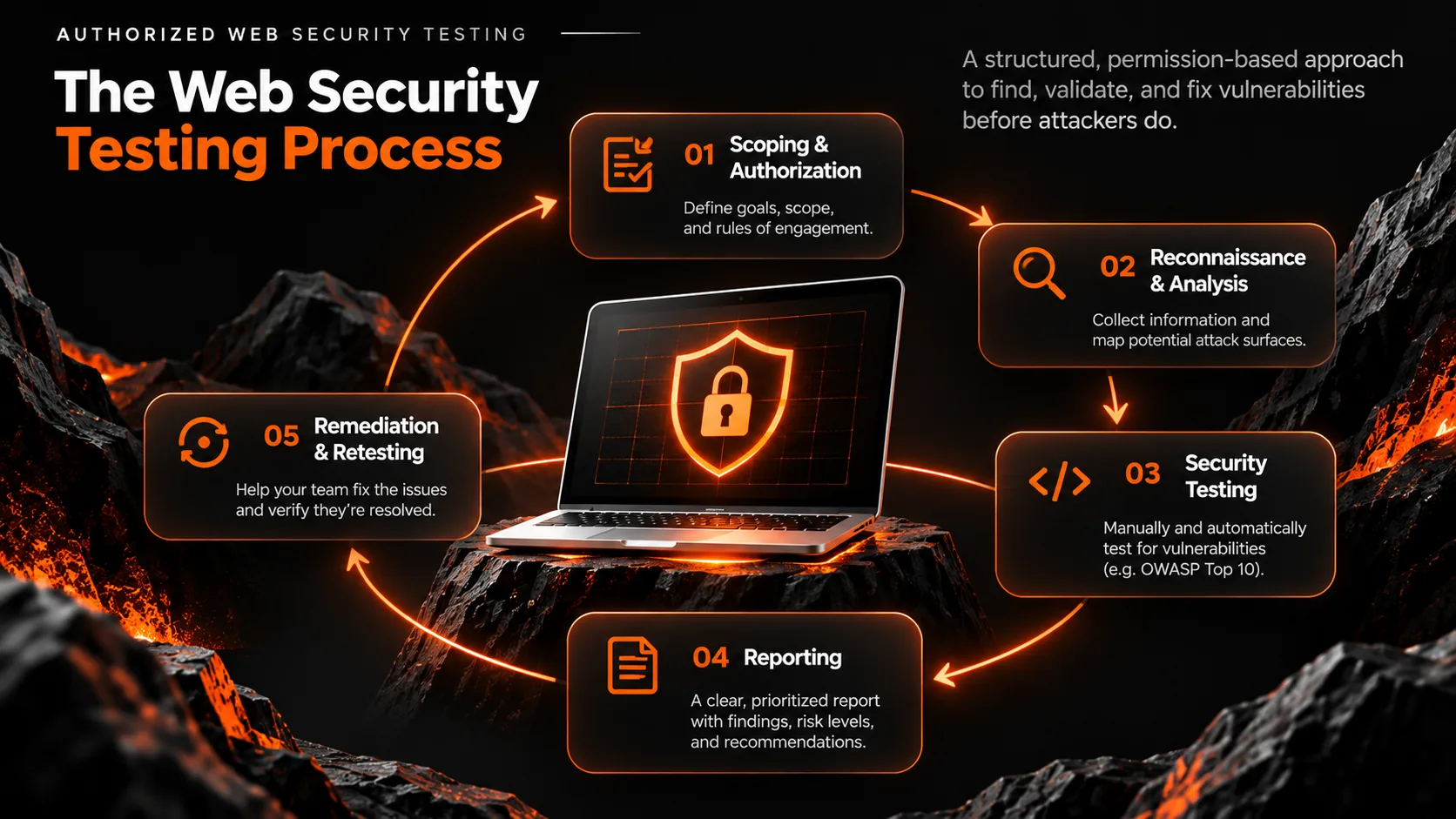
Stage 1: Discovery and scoping
The work starts with understanding the system. The team and the client identify:
- Applications and domains
- Relevant infrastructure
- APIs and integrations
- Authentication requirements
- Sensitive business functions
- Operational restrictions
- Testing objectives
This stage also produces the written authorization and the Rules of Engagement.
Stage 2: Security review and assessment
The team examines the agreed systems: configuration, authentication controls, application behaviour, dependencies and security architecture.
Tools help with known patterns. Manual analysis is usually needed to understand risks that are specific to this application.
Stage 3: Controlled validation
A suspected weakness becomes a finding only when it is confirmed. Validation uses the least disruptive method that proves the point.
Testing stays inside the scope and avoids unnecessary access to personal data. Evidence should be enough to reproduce the issue and no more than that.
Stage 4: Risk assessment
Findings are rated by potential impact and by the conditions required to exploit them:
- Technical severity
- Business impact
- Accessibility of the affected system
- Existing security controls
- Sensitivity of affected information
- Likelihood of misuse
A low-severity configuration issue and a broken authorization check need different responses and different deadlines.
Stage 5: Reporting
The client receives a structured report. A useful one contains:
- Executive summary
- Scope and methodology
- Identified vulnerabilities
- Severity and business impact
- Supporting evidence
- Remediation recommendations
- Limitations of the assessment
It should be readable by the development team and by the person who approves the budget.
Stage 6: Remediation and retesting
Testing creates value when the findings are fixed. Developers and administrators plan the work by risk and business priority.
Retesting confirms which issues are closed and which remain open. Without that step, nobody knows whether the fix worked.
Finding a vulnerability is the start of the work. Fixing it is what reduces the risk.
7. What a finding looks like in practice
Consider a store with a customer account area. An invoice opens at `/account/invoice/1042`. A signed-in customer changes the number and sees someone else's invoice, with their name, address and order history.
The interface still looks normal, the login still works, no error appears, and no alert fires. The missing piece is a server-side check that the invoice belongs to the signed-in account.
The fix is small: authorize every object request against the current user, return a neutral response when access is denied, add a regression test that tries another account's ID, and log invoice access so abuse is visible.
This scenario is illustrative, built from the broken access control category in the OWASP Top 10; it is not a client engagement. It shows why manual validation matters: a scanner sees a page that works, a tester sees whose data the page returns.
The studio's website pentest demo runs a similar assessment as a simulation in the browser. It is labelled as an example environment and scans nothing. Web application penetration testing and pricing
8. What a security report should include
A report should do more than list technical warnings. It should help the business decide what to fix and in what order.
Executive summary
A nontechnical overview of the most important risks, the systems affected and the recommended priorities. It exists so management can make a decision without reading raw output.
Technical findings
Detailed descriptions for developers and administrators. Each finding should identify the affected component, the observed behaviour, the potential impact, the steps to reproduce it and the recommended remediation.
Evidence needs to be specific enough to reproduce the issue, and handled carefully enough not to expose customer data to people who do not need it.
Remediation roadmap
A prioritised action plan based on severity, business impact and implementation effort. Where appropriate, it separates immediate mitigations from longer-term architectural improvements.
A thorough assessment is worth little if the team cannot act on it. Reports are written for the people who will do the work, and reviewed with the person who owns the risk.
9. How often should businesses test?
There is no universal schedule. The right frequency depends on the system's risk profile, complexity, exposure and rate of change.
Assessments are particularly valuable:
- Before launching a new application
- After major architectural changes
- Following significant authentication or payment updates
- When introducing sensitive integrations
- After a security incident
- When required by contractual or compliance obligations
- As part of a recurring assurance programme
Some organisations run an annual penetration test as a baseline and add reviews after major changes. Others test more often because the application changes weekly or handles particularly sensitive information.
Automated monitoring can complement periodic manual work. It does not replace it, and a clean dashboard is not evidence that access control works.
10. Does testing guarantee that a site is secure?
No. A test examines a system within a particular scope at a particular time. It cannot prove that every weakness has been found.
New weaknesses appear through:
- Software updates
- New features
- Configuration changes
- Third-party dependencies
- Infrastructure modifications
- Changes in attacker techniques
Testing gives evidence about the state of the assessed systems at that moment. It is not a permanent certificate.
A mature security programme also includes:
- Secure development practices
- Dependency management
- Access control reviews
- Backups and recovery planning
- Monitoring and logging
- Incident response procedures
- Regular patching
- Security awareness
Security is an ongoing process, not a one-time certification.
11. Testing WordPress and WooCommerce sites
WordPress and WooCommerce power many business sites and online stores. Their ecosystems make highly customised builds possible, and they make dependency management necessary.
For a WordPress system, an authorized assessment may examine:
- WordPress core and plugin versions
- Administrative account security
- User roles and capabilities
- Custom theme functionality
- REST API access controls
- File and directory permissions
- Authentication and session handling
- Third-party integrations
- Backup and configuration security
WooCommerce considerations
eCommerce adds its own requirements. Testing may focus on:
- Customer account access
- Order information exposure
- Checkout workflow integrity
- Coupon and discount logic
- Payment gateway integrations
- Refund and order-management permissions
- Customer data protection
Payment data is the most sensitive part. Use a payment provider that keeps card data out of your systems, and understand your responsibilities under the applicable card-industry rules.
For stores with custom plugins or integrations, review the custom code as well. The core is usually the best-maintained part of the site.
12. Testing SaaS platforms and custom applications
SaaS products often have more complex requirements than a marketing site. One application can serve many organisations, roles and permission levels.
Assessments may examine:
- Tenant isolation
- Role-based access control
- API authorization
- Authentication workflows
- Data access boundaries
- Administrative permissions
- Third-party integrations
- Logging and monitoring
- Secrets management
- Infrastructure configuration
A multi-tenant product has to prove that users from one organisation cannot reach another organisation's private data. That requirement belongs in the architecture, not only in a pre-launch test.
The same applies to audit logs, secrets management and administrative access. Retrofitting them after launch is expensive, and sometimes impossible without a partial rewrite.
13. How much does authorized testing cost?
Costs vary with scope, complexity, testing depth and reporting requirements. A small informational site needs a different level of assessment from a SaaS platform with several APIs and user roles.
Factors that move the price:
- Number of applications and endpoints
- Authentication complexity
- Number of user roles
- API coverage
- Infrastructure scope
- Manual testing requirements
- Business logic complexity
- Reporting requirements
- Retesting arrangements
Compare scope and deliverables rather than the lowest quote. An inexpensive automated scan is not equivalent to a manual penetration test, and a fixed price with no scope is not a proposal.
A clear proposal states what will be assessed, what is excluded, and what evidence and reporting the client will receive. It also names the people who will do the work.
14. How to choose a provider
Choose a partner on process and evidence, not on a wall of badges.
Do they require written authorization?
A professional provider establishes permission and boundaries before beginning, and will not start without them.
Do they follow a recognised methodology?
Ask which guidance informs the work. The common references are:
These frameworks help compare proposals and check that the work is repeatable.
Is manual testing included?
Automated scanning finds common issues. Manual analysis is what finds authorization weaknesses and business logic problems, which are the ones that tend to matter most.
What will the final report contain?
Ask for a sample with sensitive details removed. A report without reproduction steps and priorities is a list of warnings, not a plan.
Is retesting available?
Verification after remediation is how the client knows the fix worked. It should be priced and scheduled in advance, not improvised later.
How is sensitive information protected?
The provider should explain how evidence, credentials and client data are stored, shared and deleted.
Do they understand your technology stack?
Experience with the framework, architecture and business workflows improves assessment quality. So does the honesty to decline work outside that experience.
A provider who cannot answer these questions before the contract is unlikely to answer them during an incident.
15. How Waytrel Studio approaches web security
At Waytrel Studio, security is part of engineering, not a separate product bolted on at the end.
The work starts with authorization and scope. We test authentication, access control and configuration on systems we are permitted to test, and we write down what is out of scope before anything runs.
Assessments use the OWASP Web Security Testing Guide and the Application Security Verification Standard as reference frameworks, with NIST SP 800-115 for process. Findings are reproduced, rated by impact and paired with a fix the team can implement.
On qualifications: the work is led by the developer who builds and maintains these systems. We do not claim certifications we do not hold. When a project needs a certified auditor, a regulated attestation or a formal letter for an insurer, we say so and help scope that engagement instead.
The pentest demo on this site runs a simulated assessment in the browser. It is labelled as an example environment and scans nothing; it shows the shape of the work, not a result.
If a site needs rebuilding rather than testing, the bespoke development guide covers process, timelines and budgets. Bespoke website development
Choosing a studio is a separate decision. The guide to hiring a digital design studio lists the questions worth asking before signing. How to hire a digital design studio
After remediation, sites still need updates, backups and monitoring. The maintenance plans cover that side of the work. Website maintenance and support
16. Authorized testing checklist
Before commissioning an assessment, answer these questions.
- Do we know which systems require testing?
- Have we identified who can authorize the assessment?
- Is the scope documented?
- Are testing restrictions clearly defined?
- Have we identified critical business workflows?
- Are emergency contacts established?
- Do we understand how sensitive information will be handled?
- Will we receive a detailed report?
- Is there a remediation process?
- Can important fixes be retested?
A structured engagement removes most of the uncertainty and gives the assessment a chance to produce useful results.
Frequently asked questions
Is authorized web security testing legal?
Authorized testing is generally conducted with permission from the party entitled to approve the work. Legality still depends on the jurisdiction, the contract, the methods used and the systems involved. Written authorization and a defined scope are the basic safeguards.
Is penetration testing the same as vulnerability scanning?
No. Scanning identifies potential weaknesses, often with automated tools. Penetration testing validates selected risks through manual, controlled testing inside an authorized scope.
Can security testing damage a website?
Some activities can affect performance or availability if they are not planned. Professional engagements set restrictions, safeguards and communication procedures to keep operational risk low.
Should small businesses invest in security testing?
Small businesses benefit when their sites process customer information, payments or sensitive business data. The scope should match the actual risk and the available budget, not a template.
Does an SSL certificate mean my website is secure?
No. HTTPS encrypts traffic between the browser and the server. It does not fix application vulnerabilities, weak configurations or broken access control.
Can security testing improve SEO?
Testing is not a ranking tactic. Preventing compromises, malicious redirects and downtime protects availability, reputation and the user experience, which search engines and customers both notice.
How long does an assessment take?
It depends on the number of systems, application complexity, testing depth and reporting. A small assessment can take several days; a complex engagement can run for weeks.
Final thoughts: security is part of building better products
Authorized web security testing should not wait for an incident. It belongs in the same plan as backups, monitoring and maintenance.
Modern sites depend on connected systems, sensitive data and application logic that changes often. Understanding where those systems can fail helps a business decide before a problem becomes an emergency.
The sequence is simple to state and harder to practise: get authorization, define the scope, assess responsibly, document findings, fix what matters and verify the fix.
A good website should look right, work well and hold up under scrutiny. Security is part of that standard.
Related services
- Web application penetration testing
- Web development
- Website maintenance and support
- UI/UX and product design
Related reading
Prepared by Waytrel Studio. This is general guidance, not legal advice; authorization requirements depend on jurisdiction, contracts and hosting providers. The invoice scenario is illustrative and not a client engagement. Waytrel Studio does not claim certifications it does not hold.