Waytrel Journal · Security
How Ethical Hacking for Websites Keeps Your Business Safe
Learn how ethical hacking for websites works, what it can uncover, how much it costs, and why authorized assessments belong in a modern website security strategy.
Discuss a security assessment ↗
On this page
Your website looks great. It loads quickly, customers can navigate it easily, and everything seems to work exactly as intended.
But here's a question most business owners never ask:
What happens when someone uses your website in a way you never intended?
A login form designed to protect accounts might contain an overlooked weakness. An API built to simplify integrations might expose information it shouldn't. A seemingly harmless plugin could introduce a vulnerability that affects your entire website.
These problems don't always produce visible errors. Sometimes, everything looks perfectly normal.
That's where ethical hacking for websites comes in.
Instead of waiting for someone with malicious intentions to discover a weakness, ethical hackers help businesses identify and address security risks through controlled, authorized assessments.
And in a world where websites handle payments, customer information, and critical business operations, understanding those risks is increasingly important.
Let's explore how ethical hacking works, what it can uncover, and why it belongs in a modern website security strategy.
This guide focuses on the business case and how an assessment runs. Permission and the legal line are covered separately, and a practical website penetration testing guide covers scope, cost and preparation. Why authorized web security testing is non-negotiable · What is website penetration testing and do you need it?
1. What is ethical hacking for websites?
Ethical hacking is the practice of evaluating computer systems for security weaknesses with explicit permission from the person or organization authorized to approve the testing.
When applied to websites, it focuses on identifying vulnerabilities in web applications, authentication systems, APIs, integrations, and related infrastructure.
The objective is simple: find security weaknesses before malicious actors can take advantage of them.
Ethical hackers use security knowledge and assessment techniques to understand how an application might be misused. Unlike malicious attackers, they operate within an agreed scope and follow documented rules.
A professional engagement typically includes:
- Written authorization
- Clearly defined testing boundaries
- Agreed assessment methods
- Operational safeguards
- Responsible handling of sensitive information
- Documented findings
- Recommendations for remediation
Ethical hacking isn't about breaking things for the sake of proving a point. It's about understanding where security controls may fail and helping organizations improve them.
2. Ethical hacking vs. malicious hacking: what's the difference?
Ethical hackers and malicious attackers may study similar technologies and security weaknesses. The fundamental differences are authorization, intent, and conduct.
| Ethical hacking | Malicious hacking |
|---|---|
| Conducted with explicit permission | Conducted without valid authorization |
| Operates within defined boundaries | May disregard legal and operational boundaries |
| Aims to identify and reduce risks | May seek unauthorized access, disruption, or financial gain |
| Documents findings responsibly | May conceal activity or misuse information |
| Protects sensitive data during testing | May steal, expose, or manipulate data |
| Supports remediation | May exploit vulnerabilities for harmful purposes |
An ethical hacker doesn't automatically have permission to test any publicly accessible website. Even when the intention is to help, unauthorized testing can violate laws, contracts, or service-provider policies.
That's why professional security engagements begin with written permission and a clear Rules of Engagement document.
Technical ability doesn't make an activity ethical. Authorization and responsible behavior do.
3. Why businesses need ethical website hacking
Modern business websites do much more than display information. They connect services, process transactions, manage accounts, and exchange data with external systems.
A typical online business may depend on:
- Customer databases
- Payment gateways
- CRM systems
- Inventory management platforms
- Authentication providers
- Marketing automation services
- Cloud infrastructure
- Third-party APIs
Each additional component creates dependencies that need to be secured. A vulnerability in one part of the system may affect others.
Protecting customer data
Customer information is one of the most important assets many websites handle. Depending on the business, this may include names, contact information, order histories, account details, and other personal data.
Ethical security assessments help identify weaknesses that could expose this information to unauthorized access.
Preventing operational disruption
A compromised website can interrupt sales, customer support, and internal workflows. For eCommerce businesses and SaaS platforms, even a temporary interruption can affect revenue and customer relationships.
Reducing financial exposure
Security incidents can generate costs associated with investigation, recovery, legal obligations, system restoration, and business interruption. Proactive security testing can help identify preventable risks before they become expensive problems.
Protecting brand reputation
Customers expect businesses to take reasonable steps to protect their information. A significant security incident can undermine that trust — and rebuilding trust is often more difficult than fixing the technical issue itself.
4. What can ethical hackers find on a website?
Ethical hacking for websites can reveal security weaknesses that ordinary functional testing may overlook. Many assessments draw on guidance from the OWASP Top 10, a widely recognized reference for web application security risks. OWASP Top 10
Here are some common categories.
Broken access control
Access control determines which users can access particular resources or perform specific actions. When these controls fail, users may gain access to information or functionality outside their permissions.
For example, an online store must ensure that customers cannot view another customer's private order information. Security testing evaluates whether authorization is properly enforced.
Authentication weaknesses
Authentication mechanisms protect user accounts and administrative interfaces. An assessment may examine:
- Login security
- Account recovery
- Multi-factor authentication
- Session expiration
- Cookie configuration
- Administrative access
- Protection against automated login attempts
The objective is to identify weaknesses that could increase the likelihood of unauthorized account access.
Injection vulnerabilities
Injection vulnerabilities occur when an application handles untrusted input unsafely. Depending on the underlying technology, this can affect database operations or other application processes. Secure development practices, including parameterized queries and appropriate input handling, help reduce these risks.
Cross-site scripting (XSS)
Cross-site scripting occurs when an application allows untrusted content to be interpreted as executable code in a user's browser. Depending on the context, this can affect page behavior, user interactions, or sensitive information. Appropriate output encoding and safe rendering practices are important defenses.
Security misconfiguration
Even a well-developed application can become vulnerable through incorrect configuration. Examples include:
- Unnecessary exposed services
- Excessive user permissions
- Insecure cloud storage settings
- Debug functionality enabled in production
- Outdated server components
- Improperly protected administrative interfaces
Security assessments can identify configurations that require attention.
Vulnerable dependencies
Websites commonly rely on external libraries, plugins, frameworks, and services. If these components contain known vulnerabilities, they may introduce security risks into otherwise well-designed systems. Regular dependency management is therefore essential.
Business logic vulnerabilities
Some weaknesses are not traditional coding errors. They arise when an application allows users to manipulate business processes in unintended ways — for example discount calculations, refunds, account permissions, or order workflows.
These issues often require manual analysis because automated scanners may not understand the application's business rules.
5. How does ethical hacking for websites work?
Professional ethical hacking follows a structured assessment process. The exact methodology depends on the application's architecture, business requirements, and authorized scope.
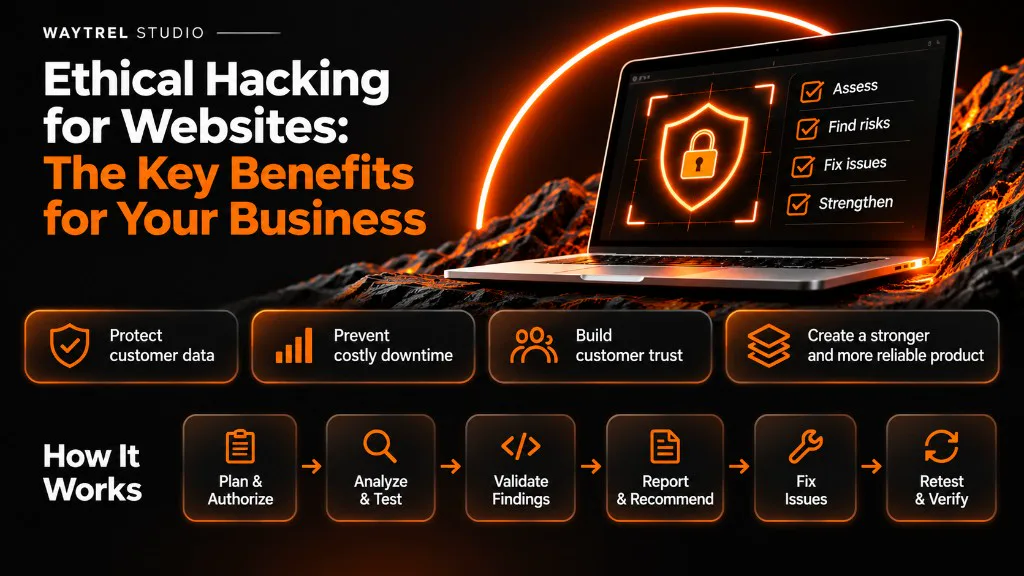
Step 1: Authorization and planning
Before any testing begins, the client and security provider establish the scope. They identify:
- Applications and domains included
- Systems excluded from testing
- Assessment objectives
- Permitted activities
- Testing schedule
- Operational restrictions
- Emergency contacts
- Data handling requirements
This protects both parties and helps minimize operational risk.
Step 2: Understanding the application
The testing team reviews the authorized environment to understand its architecture and functionality. This may include evaluating application components, authentication workflows, integrations, and user roles. The goal is to identify areas where security controls require closer examination.
Step 3: Vulnerability assessment
The team examines the application for potential security weaknesses. Automated tools can help identify common configuration issues and known vulnerabilities. Manual analysis provides additional insight into application-specific behavior, access controls, and business logic.
Step 4: Controlled validation
Potential weaknesses are evaluated to determine whether they represent genuine security risks. Validation should follow the agreed Rules of Engagement and use the least disruptive methods necessary. The objective is to establish meaningful evidence without unnecessarily affecting production systems or sensitive information.
Step 5: Security reporting
The findings are documented in a report. A useful report should explain:
- What was discovered
- Which components are affected
- Potential business impact
- Risk severity
- Recommended remediation
- Assessment limitations
The report should provide enough information for developers and administrators to address the findings.
Step 6: Remediation and retesting
Identifying vulnerabilities is only part of the process. The development team implements fixes, and important findings are retested to verify whether the weaknesses have been resolved.
The value of ethical hacking isn't measured by how many vulnerabilities are found. It's measured by how effectively security risks are reduced.
6. Ethical hacking vs. automated security scanning
Automated security scanners are valuable tools, but they are not equivalent to a comprehensive ethical hacking engagement.
Automated scanning can help identify:
- Known software vulnerabilities
- Outdated dependencies
- Certain configuration problems
- Missing security controls
- Common application weaknesses
However, automated tools may miss complex authorization problems and business logic vulnerabilities. They may also generate false positives that require manual verification.
Professional ethical hacking combines tools with human analysis. An experienced security professional can examine how application components interact and evaluate risks in the context of the business.
For many organizations, combining automated monitoring with periodic manual assessments provides a more effective approach than relying on either alone.
7. Which websites benefit most from ethical hacking?
Security assessments can benefit many types of websites, but some applications have particularly important requirements.
eCommerce websites
Online stores process customer information, orders, and payment-related workflows. Ethical hacking may help identify weaknesses in:
- Customer account permissions
- Checkout processes
- Order management
- Payment integrations
- Coupon and refund logic
- Administrative functionality
For WooCommerce websites, custom plugins and integrations may require particular attention.
SaaS applications
SaaS platforms often serve multiple customers through shared infrastructure. Security assessments may focus on:
- Tenant isolation
- API authorization
- User roles and permissions
- Authentication systems
- Sensitive data access
- Administrative controls
A multi-tenant application must ensure that information belonging to one customer cannot be accessed by another without authorization.
WordPress websites
WordPress provides extensive flexibility through plugins, themes, and custom development. However, security depends on appropriate configuration, maintenance, and development practices. Assessments may review:
- WordPress core and plugin security
- Administrative access
- Custom theme functionality
- REST API permissions
- User roles
- Hosting configuration
- Third-party integrations
Custom web applications
Custom applications may contain specialized workflows that generic scanners cannot fully evaluate. Manual security analysis is particularly valuable when an application has complex authorization rules or business logic.
8. How often should a website be tested?
There is no universal testing frequency suitable for every organization. The appropriate schedule depends on application complexity, business risk, and how frequently the system changes.
Ethical security assessments are particularly valuable:
- Before launching a new website or application
- After major feature releases
- Following significant infrastructure changes
- When introducing sensitive integrations
- After a security incident
- When required by applicable standards or contracts
- As part of an ongoing security program
Some organizations conduct annual penetration tests as a baseline. Higher-risk or frequently changing applications may require more regular assessments.
Automated monitoring can complement these activities, but it does not replace deeper manual testing.
9. How much does ethical hacking for websites cost?
The cost of an ethical hacking engagement depends on the scope and complexity of the system. A small informational website requires a different assessment from a SaaS application with multiple APIs, user roles, and sensitive integrations.
Factors affecting cost include:
- Number of applications
- Authentication complexity
- Number of user roles
- API coverage
- Custom functionality
- Manual testing requirements
- Infrastructure scope
- Reporting and retesting arrangements
Illustrative Budget Ranges
These figures are broad planning examples rather than verified market averages or quotations from Waytrel Studio.
| Website type | Illustrative budget |
|---|---|
| Small business website | $500–$2,000 |
| WordPress or WooCommerce website | $1,000–$5,000 |
| Custom web application | $2,000–$10,000 |
| SaaS platform | $5,000–$20,000+ |
| Complex enterprise environment | Custom quotation |
Actual pricing may fall outside these ranges. Businesses should compare providers based on scope, methodology, reporting quality, and technical expertise rather than price alone.
Fixed-scope starting prices for Waytrel Studio web application penetration tests are published on the service page. Web application penetration testing
10. How to choose an ethical hacking provider
Selecting a security partner requires careful evaluation. Before hiring, ask several important questions.
Do they require written authorization?
A professional provider should never begin testing without appropriate permission.
Do they follow recognized security methodologies?
Useful references include:
These resources help structure security assessments and evaluate application security requirements.
Is manual analysis included?
Automated scanning alone may not provide sufficient coverage for complex applications.
Will you receive actionable recommendations?
The report should explain how to address identified weaknesses, not simply list technical warnings.
Is retesting available?
Retesting helps verify whether remediation has been successful.
How will sensitive information be protected?
The provider should explain how test credentials, findings, and confidential data will be handled.
Do they understand your technology stack?
Relevant experience with your application's architecture and integrations can improve assessment quality.
11. Ethical hacking is not a guarantee of security
One of the most important things business owners should understand is that no single assessment can guarantee complete security.
A security test evaluates selected systems within a defined scope and time period. New vulnerabilities may emerge through:
- Software updates
- New features
- Infrastructure changes
- Third-party integrations
- Newly discovered weaknesses
- Configuration mistakes
Ethical hacking should therefore be part of a broader security strategy. That strategy may also include:
- Secure development practices
- Regular software updates
- Access control reviews
- Monitoring and logging
- Backup and recovery procedures
- Dependency management
- Incident response planning
- Security awareness training
A secure website isn't a finished product. It's a system that requires continuous attention.
12. Why security should be part of website development
Security is often treated as something to address after development is complete. That approach can create unnecessary costs and technical complications.
A more effective strategy incorporates security considerations throughout the development lifecycle.
During planning
Teams identify sensitive information, authentication requirements, and important business workflows.
During architecture
Developers consider access controls, system boundaries, integrations, and infrastructure security.
During development
Secure coding practices, code reviews, and dependency management help reduce common weaknesses.
Before launch
Security assessments can identify important issues before the application becomes publicly available.
After launch
Monitoring, updates, vulnerability management, and periodic testing help maintain security as the application evolves.
This approach is often described as integrating security into the software development lifecycle. It helps reduce the need for expensive reactive fixes.
13. How Waytrel Studio approaches website security
At Waytrel Studio, we believe great digital experiences require more than attractive interfaces. They require thoughtful engineering, maintainable architecture, and appropriate security controls. Waytrel Studio
When considering website security, we emphasize principles such as:
- Clear authorization and defined assessment boundaries
- Security-conscious architecture
- Responsible vulnerability assessment
- Protection of sensitive information
- Practical remediation recommendations
- Maintainable code and infrastructure
- Ongoing technical improvements
Security should complement design and functionality rather than compete with them. A website can be visually distinctive, intuitive, fast, and built with security in mind.
14. Ethical hacking checklist for business owners
Before arranging an ethical hacking engagement, review the following questions:
- Do we know which websites and applications need assessment?
- Can we authorize testing for all included systems?
- Have we documented the assessment scope?
- Are testing restrictions clearly defined?
- Have we identified sensitive customer information?
- Are appropriate backups available?
- Have we notified relevant technical teams?
- Will the provider conduct manual analysis?
- Will we receive a detailed security report?
- Is there a process for fixing vulnerabilities?
- Can important fixes be retested?
A structured assessment helps businesses turn security concerns into practical improvements.
Frequently asked questions
Is ethical hacking for websites legal?
Ethical hacking is conducted with authorization from the party legally entitled to approve the assessment. However, legality also depends on jurisdiction, contractual obligations, testing methods, and the systems involved. Written authorization and a defined scope are essential.
Is ethical hacking the same as penetration testing?
The terms are closely related but not identical. Ethical hacking is a broader concept covering authorized security assessment activities. Penetration testing is a structured assessment that validates selected security weaknesses through controlled testing.
Can ethical hackers access customer information?
Security testing may reveal weaknesses affecting sensitive information. Professional testers should minimize access to real customer data and follow agreed data handling requirements.
Does every website need ethical hacking?
Not every website requires a comprehensive penetration test. However, websites handling sensitive information, user accounts, payments, or complex integrations may benefit from professional security assessments.
Can automated tools replace ethical hackers?
Automated tools are useful for identifying common weaknesses, but they may miss complex authorization and business logic issues. Manual analysis remains important.
Can ethical hacking prevent all cyberattacks?
No. Ethical hacking helps identify and reduce security risks, but it cannot guarantee that a website will never be compromised.
Is WordPress safe for business websites?
WordPress can be used securely when properly developed, configured, updated, and maintained. Security depends on the entire implementation, including plugins, themes, hosting, and access controls.
How long does an ethical hacking assessment take?
The timeline depends on the application's complexity and the agreed scope. A small assessment may take several days, while complex applications can require multiple weeks.
Final thoughts: ethical hacking is about prevention, not fear
Cybersecurity doesn't have to begin with a breach. Ethical hacking gives businesses an opportunity to understand potential weaknesses before they become serious incidents.
For online stores, SaaS platforms, and modern business websites, proactive security assessments can help protect customer information, reduce operational risks, and improve confidence in digital infrastructure.
But ethical hacking works best when it's part of a broader commitment to secure development and ongoing maintenance.
The goal isn't to make a website impossible to attack. It's to make security risks visible, manageable, and less likely to cause harm.
Because a great website shouldn't only look extraordinary. It should be built responsibly.
Related services
Related reading
- Why authorized web security testing is non-negotiable
- What is website penetration testing and do you need it?
- Bespoke website development: process, cost and benefits
Prepared by Waytrel Studio. This is general guidance, not legal advice. The budget ranges above are illustrative planning examples, not verified market averages and not a Waytrel Studio quotation.