Waytrel Journal · Hiring & partnerships
App Design Agency: What to Look for Before You Hire
What to check before hiring an app design agency: scope, portfolio, UI/UX expertise, technical awareness, workflow, pricing, ownership and red flags.
Discuss my project ↗
On this page
Choosing an app design agency is one of the most consequential decisions in building a digital product.
A beautiful interface attracts attention. It will not rescue an application that is confusing to navigate, expensive to maintain or hard to develop.
A mobile app, a SaaS platform and a custom business application all ask the same of a design partner: understanding of the users, the business objectives and the technical realities of shipping the product.
This guide covers what to evaluate before you sign.
1. Define what you are hiring
App design agencies do not offer the same services. Some focus on UI/UX design and prototyping. Others combine design with frontend development, backend engineering and product strategy.
Before comparing agencies, define what the project actually requires:
- UI/UX design for an existing application
- A complete mobile application built from scratch
- A SaaS dashboard or web application
- An MVP to validate a startup idea
- A redesign of an existing digital product
- A long-term technical partner
If an experienced development team is already in place, a design-focused agency may be enough. Starting from an idea and needing a working product is a different brief, and a studio that covers both design and development removes a handover.
Ask directly whether the agency delivers production-ready applications or only design files and prototypes. That answer affects the budget and the timeline more than the rate does.
2. Look past the portfolio screenshots
A polished portfolio does not prove that an agency can solve product problems. Design tools make impressive mockups easy to produce; intuitive, functional products are harder.
When reviewing a portfolio, look for evidence of decisions:
- Does the agency explain the challenges behind each project?
- Can you open and use working applications?
- Are the interfaces intuitive and consistent?
- Is there experience with similar products?
- Are accessibility and usability considered?
- Can the team explain why a particular design decision was made?
Test real products where possible instead of judging screenshots alone. A strong portfolio shows how design decisions served usability and business goals.
3. Evaluate UI/UX expertise
Good app design is not about making an interface look modern. It is about helping people reach their goal with as little friction as possible.
Take an eCommerce app. Attractive product cards and smooth animation make a strong first impression. If customers cannot find a product, compare delivery options or finish checkout, the design has failed at its main job.
An experienced agency should cover:
- User research and behaviour
- Information architecture
- User journeys and navigation
- Wireframes and prototypes
- Interaction design
- Accessibility
- Usability testing
- Design systems with reusable components
Ask how the agency validates design decisions: usability tests, user feedback, product analytics. Personal preferences are a weak basis for a product that has to work for thousands of people.
4. Check technical expertise before signing
Separating design decisions from technical reality is one of the most expensive mistakes in product work.
An agency can produce a beautiful interface full of advanced animation, complex interaction and custom components. Then the developers discover that building it takes far more time and money than the plan allowed.
That is why technical awareness matters. Even an agency that only designs should know the basic constraints of application development.
For projects that include implementation, look for experience with:
- Frontend development
- Backend architecture
- APIs and third-party integrations
- Database design
- Authentication and authorization
- Application security
- Performance optimization
- Mobile responsiveness
- Deployment and maintenance
An integrated design and development workflow surfaces technical limits while they are still cheap to fix.
Waytrel Studio connects user experience with practical engineering considerations from the first conversation. waytrel.studio
The aim is not attractive screens on their own, but a product that behaves reliably in real conditions.
5. Understand the workflow
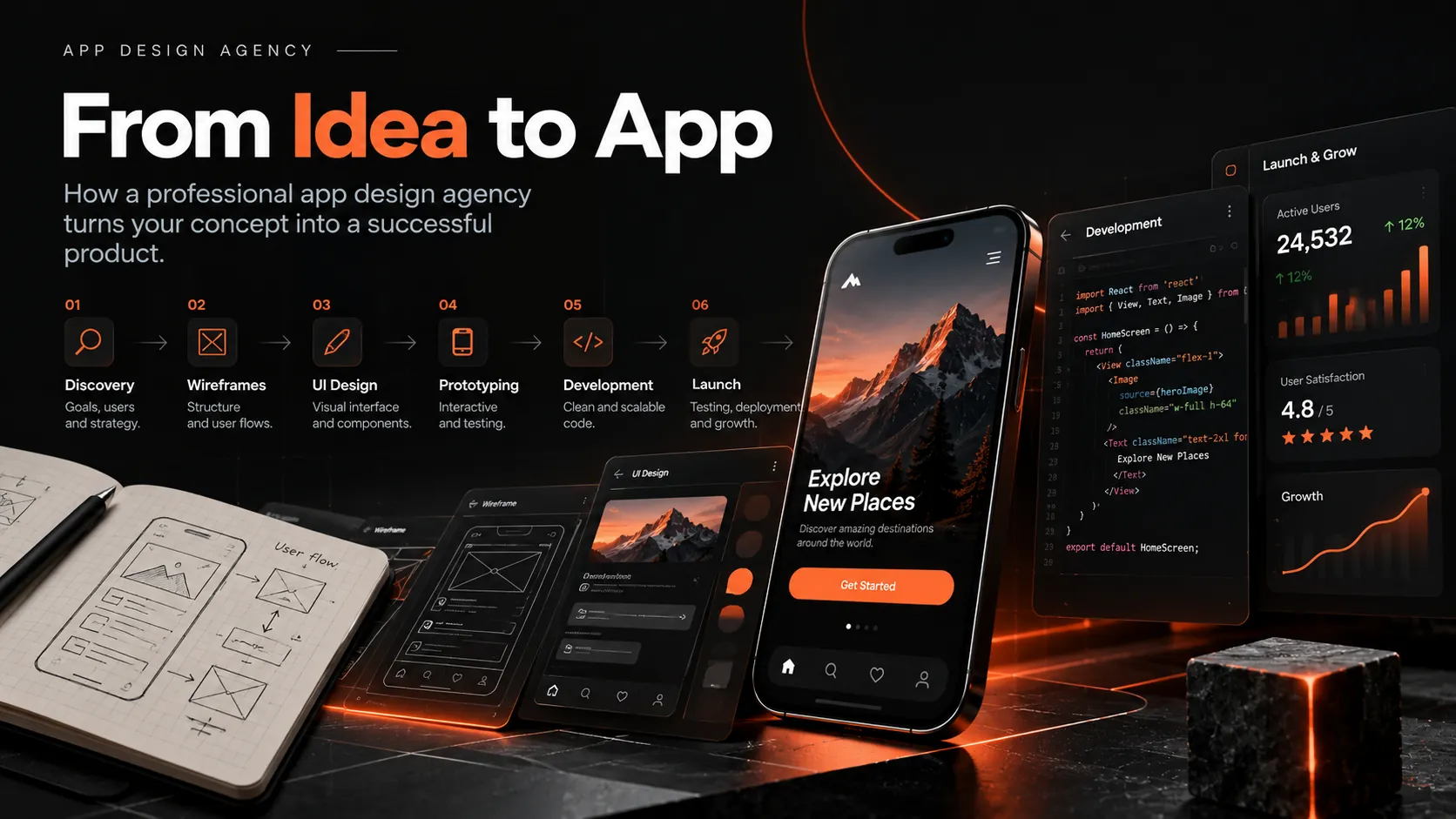
Ask the agency to walk through its process from discovery to delivery. A structured workflow usually covers six stages.
- Discovery and planning: business objectives, target users, requirements and constraints.
- User flows and wireframes: how people move through the application and how its main functionality is organised.
- UI design: typography, colour, components and interaction patterns.
- Prototyping and validation: interactive prototypes let stakeholders test navigation before development starts.
- Development and integration: engineers build the interface and connect it to services, databases and APIs.
- Testing and launch: functionality, usability, performance and reliability checks before deployment.
Not every project needs every stage in the same form. A professional agency explains which activities are necessary and why.
6. Compare pricing on total project cost
App design pricing follows complexity, scope and deliverables. An application with a few standard screens is a different job from a SaaS platform with several user roles, complex dashboards and custom integrations.
When comparing proposals, look beyond the first number:
- Discovery and research
- Number of unique screens and user flows
- Design system requirements
- Prototype complexity
- Revision allowances
- Development and integration
- Testing and quality assurance
- Maintenance and future updates
A low design quote becomes expensive when the work needs extensive rework during development. Ask for a breakdown of deliverables, assumptions, exclusions and payment milestones.
The cheapest proposal is rarely the most economical one over the life of the product.
7. Communication decides the project
Experienced teams still struggle when communication is inconsistent. Before hiring, agree on how collaboration will work.
Questions worth asking:
- Who is the primary contact?
- How often will updates arrive?
- How are milestones approved?
- What happens when requirements change?
- How are technical issues reported?
- Who coordinates designers and developers?
These questions matter more across time zones and remote teams. Clear communication prevents misunderstanding, unnecessary revision and delay.
8. Confirm that you own the assets
Ownership is often overlooked during hiring. Before signing, clarify who owns the work created for the project:
- Figma design files
- UI components and design systems
- Illustrations and visual assets
- Interactive prototypes
- Source code
- Technical documentation
- Deployment configurations
Check the licensing of third-party fonts, illustrations and software components as well. Your business needs the rights and the access to keep developing the product after the engagement ends.
9. Red flags worth noticing
Not every agency fits a serious digital product. Be cautious when you see:
- Unrealistic deadlines. Complex applications need planning, implementation, testing and iteration.
- No discovery process. Requirements that were never studied tend to surface later, at a higher price.
- Vague estimates without scope, deliverables or assumptions.
- No technical awareness. Designs that ignore implementation constraints turn into rework.
- Poor communication: irregular updates and unclear responsibilities grow into bigger problems.
- No discussion of what happens after launch, although products need maintenance and security updates.
A reliable partner is transparent about both capabilities and limitations.
10. Agency, studio or freelancers
An agency is not the only route. Individual designers and developers can be an excellent choice for a smaller project, a specialised task or a business that already has technical leadership.
Agencies and integrated studios fit work that needs coordinated design, development, testing and support. The practical difference is how much coordination your own team has to carry: with separate specialists, someone must make sure the pieces fit together.
For a detailed comparison of both models, see our guide: Design and Development Studio vs. Separate Freelancers
11. A checklist before hiring
Before the final decision, confirm:
- The agency understands your business objectives.
- You have reviewed relevant portfolio examples.
- The team has appropriate UI/UX expertise.
- Technical requirements have been discussed.
- The project scope is documented.
- Communication expectations are clear.
- Deliverables and milestones are defined.
- Ownership of assets is established.
- Testing responsibilities are understood.
- Post-launch support has been considered.
The checklist will not guarantee a perfect project. It removes the risks that were avoidable in the first place.
12. Think beyond the first release
The first version of an application is rarely the last. As the business grows, features, performance work, integrations and parts of the experience will change.
A good partner plans for maintenance from the start: reusable components, technical documentation, a consistent architecture and a deployment process that can be repeated without drama.
A product that can evolve is worth more than a fast launch that nobody can extend.
Final thoughts
Hiring an app design agency is about finding a partner who understands both the product vision and the practical work of building it.
Visual presentation and price are weak signals on their own. Look for user-centred thinking, technical understanding, transparent communication and accountability after launch.
The right partner helps you make better product decisions instead of executing a feature list.
Related services
Prepared by Waytrel Studio on 26 October 2026 from our own project practice. The illustrations are studio concept renders; the figures on their screens are demo values, not studio metrics.