Waytrel Journal · Hiring & partnerships
Design and Development Studio vs. Separate Freelancers: Which Fits Your Business?
Freelancers or an integrated studio? Compare communication, quality, cost, accountability and long-term support before choosing a team for your next digital product.
Discuss my project ↗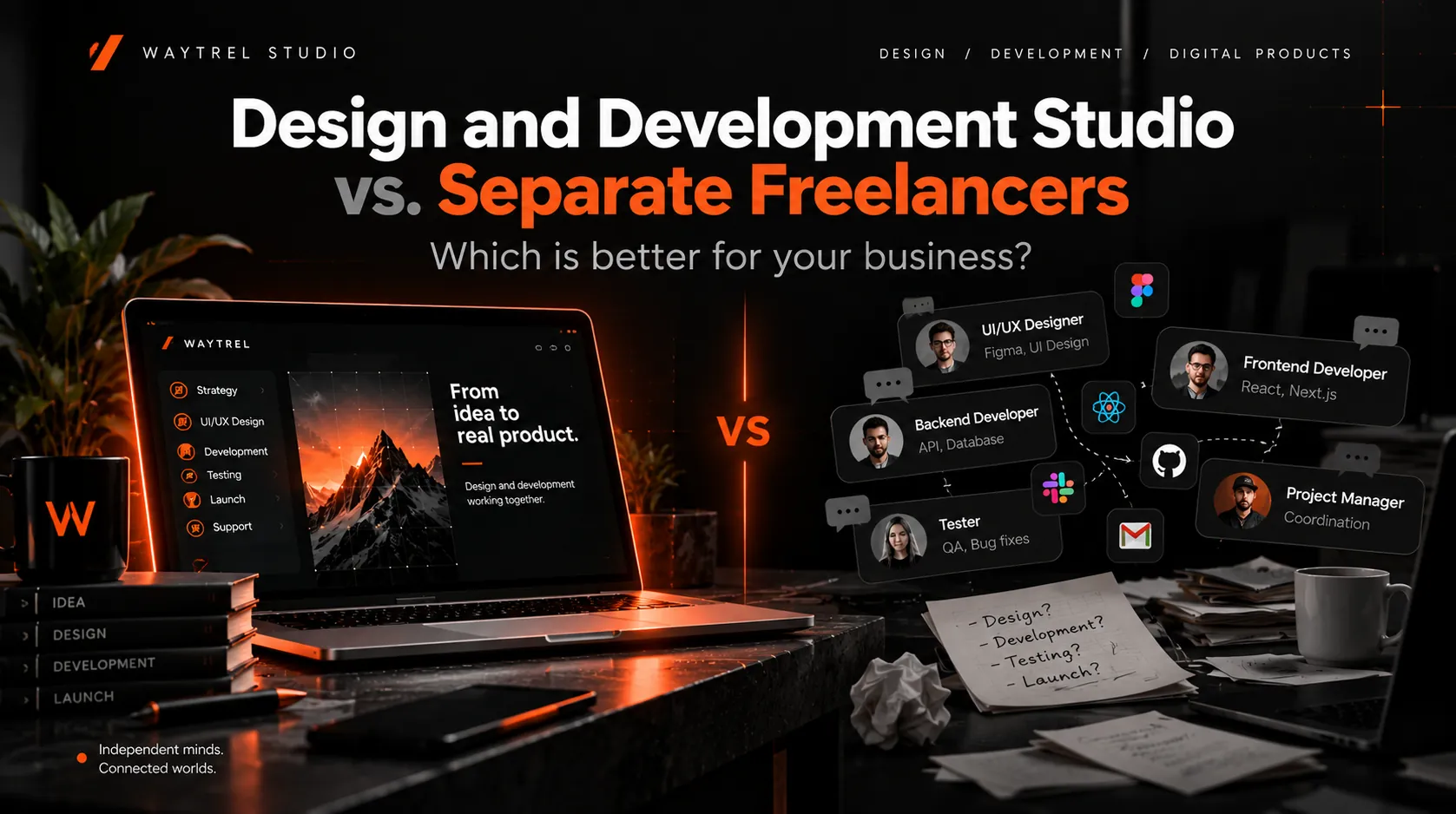
On this page
The team you choose decides whether a digital product launches in a calm, predictable way or turns into an expensive coordination problem.
A website, a mobile application, a SaaS platform or a custom digital product all start with the same question: hire individual freelancers or work with a design and development studio?
Both routes can produce excellent results. They differ in project management, communication, accountability, cost structure and what happens after launch.
Knowing those differences makes it easier to choose an approach that matches your budget, timeline and business goals.
What a design and development studio is
A design and development studio is a creative and technical partner that combines digital design with software engineering.
Instead of treating visual design and programming as separate activities, an integrated studio connects them throughout the product lifecycle.
Depending on its specialization, a studio may cover:
- UI/UX design: intuitive interfaces and a considered user experience.
- Website development: responsive, accessible and fast websites.
- Custom software development: applications built around business requirements.
- eCommerce development: online stores, payment integrations and commerce workflows.
- Mobile application development: apps for iOS and Android.
- API and backend engineering: databases, services and business logic.
- Testing and deployment: preparing a product for a production environment.
- Maintenance and optimization: support after release.
The advantage is not simply that several specialists are available in one place. It is a coordinated workflow where design decisions and engineering requirements are considered together.
How hiring separate freelancers works
The freelance model means contracting individual specialists for individual responsibilities.
A business might hire a UI/UX designer for the Figma layouts, a frontend developer to build the interface, and a backend developer to create the application logic. Testing, deployment, SEO or maintenance can go to further contractors.
The model is flexible. It works well when the scope is limited, when the business already has an experienced technical manager, or when each task genuinely stands on its own.
Someone still has to coordinate the whole process. Without clear ownership of project management and technical decisions, that work lands on the business owner, who ends up connecting the pieces.
Key differences at a glance
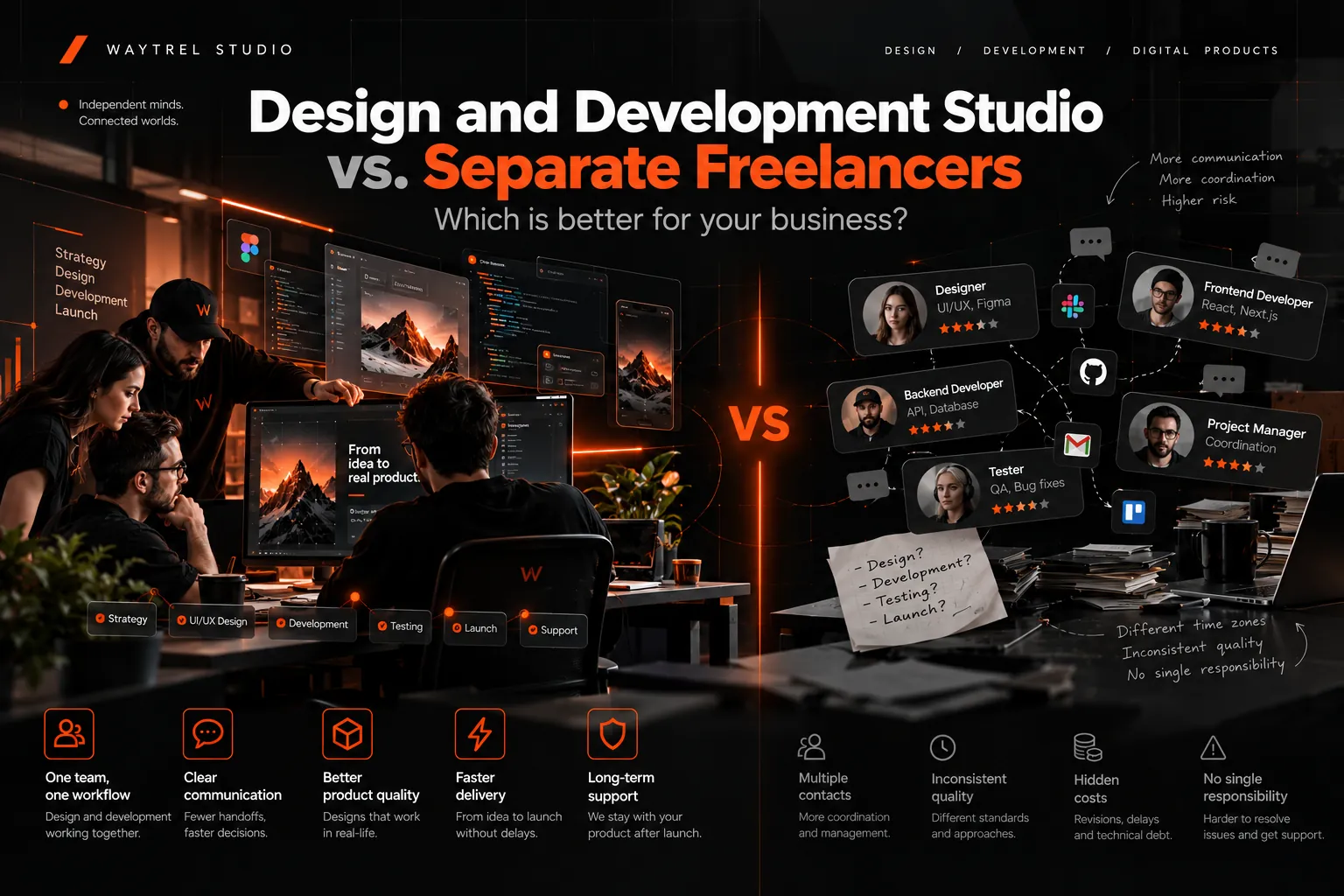
| Factor | Integrated studio | Separate freelancers |
|---|---|---|
| Communication | One coordinated workflow | Several individual contacts |
| Project management | Often included in the scope | Usually managed by the client |
| Design consistency | Shared standards and processes | Depends on how the specialists collaborate |
| Technical decisions | Coordinated across disciplines | Need explicit alignment |
| Flexibility | Limited by studio capacity | Specialists can be hired one at a time |
| Initial cost | Depends on scope and team | Potentially lower for small tasks |
| Accountability | Can be centralized in one contract | Distributed across contractors |
| Maintenance | Can stay with the same partner | May require new contractors |
Neither model is automatically better. The right choice depends on the complexity of the project and on how much coordination the client can take on.
1. Communication: one workflow or several conversations
Communication is one of the most underestimated costs in digital product development.
Take a custom eCommerce website. The designer builds an attractive checkout flow, then the developer discovers that the proposed interface conflicts with the payment provider's technical limits. Layouts go back for revision, the implementation is adjusted, and the owner approves the same screen twice.
With several independent contractors, that loop adds meetings and rework. A studio can bring technical input into the design stage, before the interface is drawn in detail.
Fewer conversations are not the goal. Better coordination between the people who make product decisions is.
2. Quality: design has to survive production
A striking interface is only one part of a product that works.
Real projects also have to account for:
- Performance on slow networks and mid-range devices
- Responsive layouts
- Accessibility
- Application security
- Backend reliability
- Database architecture
- Third-party integrations
- Search engine visibility
- Maintainability and future scaling
When designers and developers work in the same process, implementation limits appear early, while changing a decision is still cheap.
An animation that feels smooth in a prototype can stutter on an average phone. Early collaboration turns that trade-off into a decision rather than a surprise before launch.
3. Cost: are freelancers actually cheaper?
For a clearly defined, self-contained task, an independent specialist is often the most efficient option. A landing page design or a single feature does not need a studio.
On larger projects, hourly rates say little on their own. The real bill also includes coordination time, rework caused by unclear specifications, integration issues between components, delays while one contractor is unavailable, and the technical debt left by inconsistent decisions.
A studio can make the process more predictable when responsibilities, milestones and deliverables are written down. It can also cost more, because management and overhead are part of the price. Compare proposals on identical scope, never on the rate alone.
4. Accountability: who fixes it when something breaks?
The site launches, then customers report checkout errors. The designer believes the problem is in the frontend, the frontend developer suspects the API, the backend developer points at the payment gateway. Someone has to investigate.
With separate freelancers, responsibility is established through contracts and technical documentation. A studio that delivers end to end gives you one place to raise the issue.
That does not make failures impossible. It makes them easier to handle when support duties are agreed before launch.
Before hiring any partner, confirm who is responsible for testing, production incidents, bug fixes and maintenance after release.
5. Speed: delivery depends on coordination
Several freelancers can move quickly when tasks are independent and requirements are stable.
Complex products are full of dependencies. Frontend work waits for approved designs, backend integrations need agreed API contracts, and testing needs all the components available at the same time.
A shared workflow surfaces those dependencies earlier and removes avoidable waiting. The deciding factor is project management, not the number of people involved.
Ask potential partners how they organize milestones, handle scope changes and report blockers.
6. Support and growth after launch
A successful launch opens a product's lifecycle rather than closing it.
New features, conversion improvements, external services, performance work and infrastructure updates all follow. The original development partner already knows the system, which helps.
That advantage depends on documentation, code quality and continued availability of the team.
Whether you hire a studio or freelancers, make sure you receive access to:
- Source code repositories
- Design files and assets
- Hosting and deployment environments
- Domain and infrastructure accounts
- Technical documentation
- Third-party service configurations
Avoid arrangements that leave your business dependent on one provider with no way out.
7. When freelancers are the better choice
Freelancers usually fit when:
- The project is small and clearly defined.
- You need one specialist for one specific task.
- Your business already has technical leadership.
- A design system and architecture are already in place.
- You want flexible, short-term support.
An experienced independent designer or developer can deliver outstanding work. The question is whether your business has the process to fit that work into a larger project.
8. When a studio is the better choice
An integrated studio usually fits when:
- You are launching a new digital product from scratch.
- The project needs both design and engineering.
- Complex integrations or custom functionality are involved.
- You want one coordinated delivery process.
- There is no internal technical project manager.
- Development will continue after launch.
For startups and growing businesses, one partner who understands both the product experience and the implementation removes a layer of operational complexity.
9. How Waytrel Studio approaches digital products
Waytrel Studio treats digital development as a connected process rather than a collection of isolated tasks. waytrel.studio
The work starts from what the business needs the product to do, then connects interface design, technical architecture, performance and the roadmap that follows launch.
A business website, an online store, a web application or a custom integration all raise the same question: whether the technical decisions support where the product is going.
A product that holds up needs attractive visuals and clean code to work as one system.
10. Questions to ask before hiring
Before choosing a studio or a group of freelancers, ask:
- Who will manage the project and coordinate responsibilities?
- How are design decisions validated against technical requirements?
- What deliverables are included in the proposal?
- How are revisions and scope changes handled?
- Who owns the source code and design assets?
- What testing is performed before launch?
- What happens when bugs are discovered?
- Is ongoing maintenance available?
- How will progress and milestones be reported?
- What happens if the collaboration ends?
Clear answers set expectations and reduce the risk of disputes later.
Final verdict
There is no universal winner.
Choose freelancers when you need targeted expertise, the scope is manageable and you can coordinate the work yourself.
Choose a design and development studio when the project needs several disciplines, joint decisions and one delivery process.
Team size matters less than whether the people building your product communicate, take responsibility for their part and deliver something your business can keep using.
Related services
Prepared by Waytrel Studio on 22 October 2026 from our own project practice. The comparison describes typical collaboration models; which one fits depends on your scope, team and timeline.