Waytrel Journal · Product strategy & development
What Is Ongoing Product Development and How Does It Work?
How to structure ongoing product development after launch: goals, prioritization, UX research, sprint cycles and working with a studio on a retainer.
Discuss product development ↗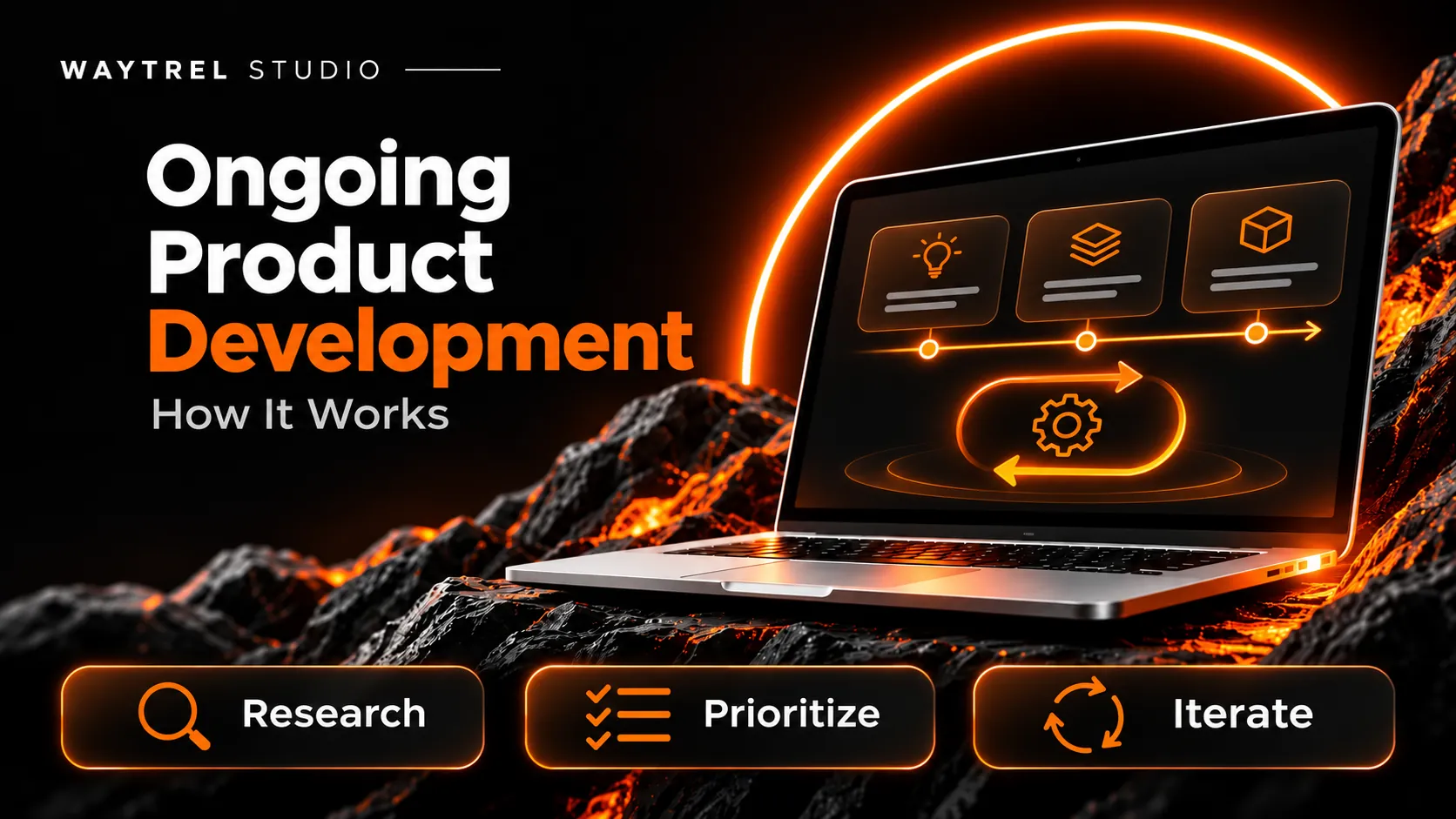
On this page
Ongoing product development is the repeating process of learning from users, choosing the most valuable problem, building a small improvement and checking what changed after release. It gives a launched app or SaaS product a way to evolve as customer needs and business priorities change.
The practical challenge is deciding what deserves the next cycle of work. A growing backlog, a busy development team and frequent releases do not automatically mean the product is getting more useful. This guide shows how to connect product goals, UX research, prioritization and delivery, including how to work with an external studio over time.
Ongoing development, maintenance and a redesign: what differs?
| Work | Primary purpose | Typical output |
|---|---|---|
| Product development | Improve a user or business outcome | A validated change to a workflow, feature or business capability |
| Maintenance and support | Keep the current product reliable and usable | A fix, compatibility update or recovery improvement |
| A defined project | Deliver a bounded change with agreed acceptance criteria | A migration, redesign or specified new module |
These workstreams share the same codebase and capacity. A reliability issue may become the highest product priority, while a large initiative may need its own scope. Keep the responsibilities visible so a retainer does not quietly turn into an unlimited feature list.
For monitoring, bug triage, incident coverage and maintenance agreements, see the companion guide. Post-launch app support: what to include
Start with one product goal and a baseline
Choose the user problem behind the business objective. “Build a dashboard” names a deliverable. “Help account owners recognise an overdue task” names a problem you can investigate and assess. Write down who experiences it, what evidence exists and what a useful improvement would look like.
- Define one primary outcome for the next planning period, such as completing a core task or returning to use a useful workflow.
- Record the current baseline and the population measured. A rate without a denominator or an observation period is difficult to interpret.
- Add guardrails: changes must not introduce unacceptable errors, accessibility barriers, slower interactions or higher operating costs.
- Name a product owner who can decide priorities, approve tradeoffs and resolve conflicting stakeholder requests.
Turn requests into a backlog with evidence
For each candidate, record the problem, affected users, supporting research, expected outcome, assumptions, dependencies and a rough effort range. Keep requests that still need research separate from work ready for implementation. A sales request can be useful evidence without automatically becoming a commitment.
A practical backlog item might read: “Customers cannot tell whether their report is still being prepared. Check the status flow, test a clearer explanation and measure successful report retrieval.” This is a fictional example, not a Waytrel Studio client result.
Use prioritization frameworks to expose assumptions
Intercom’s RICE framework compares reach, impact, confidence and effort: RICE = reach × impact × confidence ÷ effort. Use consistent periods and effort units, then make the assumptions behind each estimate visible. Intercom: RICE prioritization
| Candidate | Reach / impact / confidence | Effort | Score |
|---|---|---|---|
| Clarify report status | 400 users / 1 / 0.8 | 2 person-weeks | 160 |
| Add a dashboard widget | 100 users / 2 / 0.5 | 4 person-weeks | 25 |
The figures suggest which assumption to discuss first; they do not prove the first idea will succeed. Reach is estimated for the same period, effort uses the same unit and confidence is a fraction. Investigate weak evidence before treating a precise-looking score as a decision.
| Method | Useful when | Watch for |
|---|---|---|
| Impact versus effort | You need an initial discussion with limited data | Vague labels can hide disagreement |
| RICE | You can estimate comparable reach and effort | Unsupported inputs create false precision |
| Explicit risk and obligation review | An incident, security issue or firm commitment needs attention | Do not let an optional-feature score override an urgent obligation |
The product owner should consider dependencies and strategic fit alongside the comparison. Record why an exception was made. That explanation is more useful later than silently changing a score until a preferred idea wins.
Integrate UX research into each development cycle
Use research to answer a decision, not to fill a presentation. Observe the relevant task, speak with the people affected and test a prototype before committing to a larger implementation. Include accessibility needs in recruitment and review the proposed flow with design and engineering together.
GOV.UK’s Service Manual recommends planning research at each development phase and updating the plan as the team learns. The same principle can help a product team keep research connected to delivery. GOV.UK: planning user research
- Before building: identify the riskiest assumption and choose a suitable research method.
- During design and implementation: test the critical interaction and resolve feasibility questions early.
- After release: compare behaviour with the baseline and collect feedback from the affected users.
- Store findings, decisions and unresolved questions where the whole team can use them. Protect participant information and follow applicable research-consent requirements.

Organise sprint cycles around a useful increment
Choose a planning rhythm that fits your team and uncertainty. If you use Scrum, the Scrum Guide defines Sprints as fixed-length periods of one month or less, with a Sprint Goal and a usable increment. Releasing useful work need not wait for a Sprint Review. The Scrum Guide
| Moment | Focus | Decision or output |
|---|---|---|
| Start of cycle | Agree the goal, available capacity and ready backlog items | A focused plan and acceptance criteria |
| Early in cycle | Resolve important research and design questions | A tested direction or a smaller scope |
| Throughout the cycle | Build, review, test and prepare delivery | A usable change that meets the agreed quality bar |
| Review | Inspect the increment with relevant stakeholders | Feedback and updated priorities |
| Retrospective | Inspect how the team worked | One practical process improvement |
Research may continue across several cycles, and a small team may use continuous flow instead of Scrum. Whichever rhythm you choose, limit work in progress and make interruptions visible. When an urgent fix arrives, agree what it displaces rather than pretending capacity has increased.
Define done, then review what the release achieved
Agree completion criteria before implementation: reviewed code, appropriate tests, keyboard and accessibility checks, supported-device coverage, instrumentation, deployment notes and a recovery approach. Include performance checks for changes that affect loading or interaction.
A shipped feature is an output. Review whether it improved the selected outcome and whether the guardrails held. Activation, repeat use, task completion or support demand may help, depending on the goal. Define a review window in advance; a small sample may require more observation or qualitative research rather than a confident causal claim.
Record whether to keep, revise, expand or stop the change. Sprint velocity and the number of tickets closed can help with internal planning, but they are not proof of customer value or a reliable basis for comparing different teams.
Work with an external studio as a product partner
A studio can contribute more effectively when it has access to product context, user evidence and the reasons behind priorities. Keep one shared backlog and include the relevant designers and developers in planning and reviews. Business ownership of priorities should remain explicit.
| Responsibility | Business owner | Studio contribution |
|---|---|---|
| Goals and priority decisions | Own the desired outcome and business tradeoffs | Challenge assumptions and explain options |
| Research and solution design | Provide user access and domain context | Plan agreed research, prototype and test approaches |
| Engineering and release | Confirm constraints and approval responsibilities | Estimate, implement, review and document agreed work |
| Learning and planning | Decide what happens next | Explain release evidence, risks and capacity |
Waytrel Studio combines product design and development with ongoing product care. An engagement can be structured around recurring planning and iterations, with the scope agreed for the actual product. This gives the studio room to understand the system and contribute to decisions as well as implementation; named staffing, availability and commercial terms must be agreed rather than assumed.
What to put in a product development retainer
- Capacity and roles: who contributes, what time is available, how absences are covered and what remains outside scope.
- Planning and approvals: the backlog owner, review cadence, estimate approval and how changes affect forecasts.
- Budget boundaries: onboarding, recurring fees, external services, unused capacity and approval of additional work.
- Quality and operations: acceptance criteria, release responsibility and the separate handling of urgent support.
- Ownership and exit: business-controlled accounts, source files, decision history, documentation and a handover process.
A retainer reserves agreed capacity or deliverables; it does not make an uncertain roadmap a fixed-price promise. Ask for a short cycle report showing work completed, evidence gathered, open risks, capacity used and the next decisions. Large initiatives can be estimated separately before taking capacity from routine iteration.
A practical first-month setup
- Review the existing product, repository, analytics definitions, known risks and access ownership.
- Select a product goal and document its baseline, evidence gaps and guardrails.
- Prepare a short prioritised backlog, test the most important assumption and agree the first delivery cycle.
- Review the first usable change and the collaboration itself; update priorities and capacity for the next cycle.
This is a setup sequence, not a delivery deadline or a promise of a measurable improvement within one month. The product’s condition and access to users determine what is realistic.
Questions about ongoing product development
How much does ongoing product development cost?
The budget depends on product condition, scope, technical dependencies, research needs and the mix of roles. Ask for an onboarding estimate and a recurring capacity proposal, with external charges and additional work separated. A website-maintenance price is not a quote for product development.
Does every product need two-week sprints?
No. The example above is one planning option. Use a cadence that supports useful review and manageable changes. Teams with frequent operational interruptions may prefer continuous flow; choosing a process should follow the work.
Can another studio continue an existing product?
Yes, subject to a technical and product review. Prepare the repository, design files, setup instructions, deployment access, known issues and research history. The review may identify stabilisation work before feature development is sensible.
How do we know the arrangement is working?
Review both delivery and decisions: are risks visible, changes meeting the agreed quality bar and user evidence influencing priorities? Compare product outcomes over an appropriate period, while checking cost and reliability. Avoid judging the relationship only by hours logged or features shipped.
Before the next cycle: a checklist
- The team can explain the user problem and its connection to the product goal.
- Priorities have evidence, known assumptions and one accountable decision-maker.
- Research, implementation, maintenance and urgent support fit the agreed capacity.
- The release has acceptance criteria, guardrails and a review window.
- The business retains source files, accounts and the knowledge needed for handover.
Related services and guides
Prepared by Waytrel Studio on 23 November 2026. The guide combines editorial planning recommendations with the linked Scrum, Intercom and GOV.UK sources. Estimates, workflow examples and interfaces are illustrative. Scope and commercial terms are agreed per product.